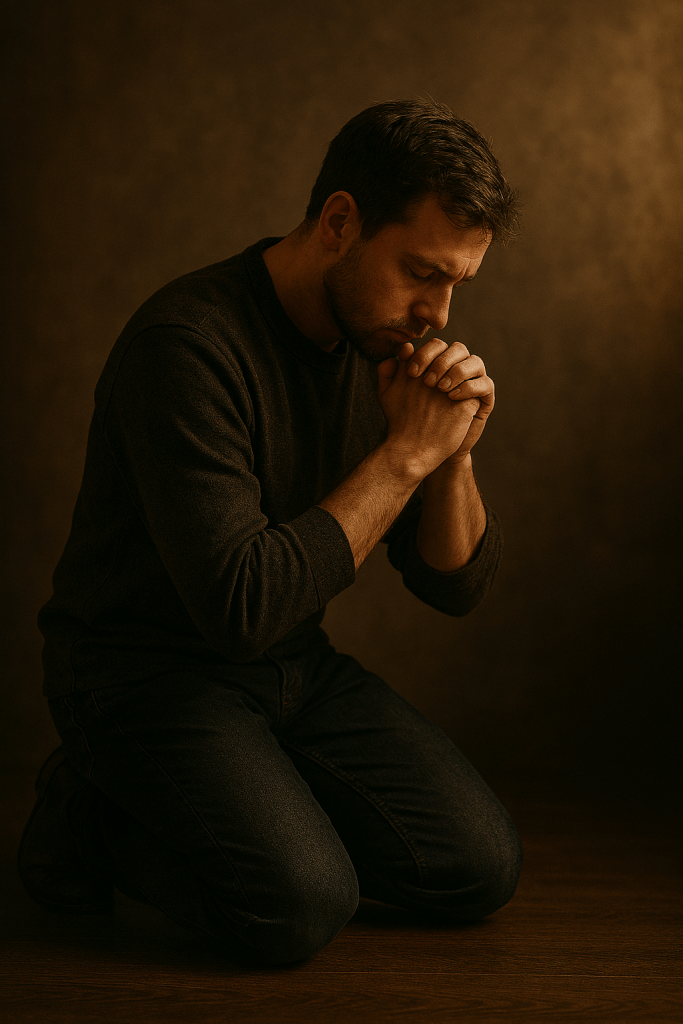
In what way have you given up your own will
And submitted to God’s instead?
And if you haven’t
And if you won’t
Then can you call yourself a Christian?
Matthew 7:21; Matthew 16:24
In what way have you given up your own will
And submitted to God’s instead?
And if you haven’t
And if you won’t
Then can you call yourself a Christian?
Matthew 7:21; Matthew 16:24
Yesterday I shared about my personal struggle with addiction, and how I only found liberation as I surrendered my will to God, taking the steps that He set before me and not my own. Then, true healing and freedom blessed my life, but I want to be very clear that it did not, and never could have, come about in the way that I wanted it to. I had to do things that I didn’t want to do, but that God chose for me.
This points to an interesting paradox in the gospel. Autonomy is essential to God’s plans for us. Right from the beginning, God created a man and a woman who were designed with the capacity to make their own choices, and He even gave them a tree to exercise their choice one way or the other.
“But of the tree of the knowledge of good and evil, thou shalt not eat of it, nevertheless, thou mayest choose for thyself, for it is given unto thee,” (Moses 3:17).
If God did not mean for man to make his own choices, God never would have set things up this way.
But also, part of God’s plan is that man should surrender his will. Thus, we are all meant to have the ability to choose our own path, but to then give it up to the Father.
“Submit yourselves therefore to God,” (James 4:7).
“I beseech you therefore, brethren, by the mercies of God, that ye present your bodies a living sacrifice, holy, acceptable unto God, which is your reasonable service,” (Romans 12:1).
Notice how Jesus followed this pattern perfectly. His autonomy was supreme and no one else had any power over him:
“I lay down my life. No man taketh it from me, but I lay it down of myself. I have power to lay it down, and I have power to take it again,” (John 10:18).
Of course, when it actually came time to lay down his life, Jesus’s own will, his autonomy, pulled him from it. It was his desire that “this cup would pass from him.” Even so, he surrendered that autonomy, declaring to his Father, “not as I will, but as thou wilt,” (Matthew 26:39).
Tomorrow let us think some more about what this means for us personally. We will consider questions such as, how do so many of us, even Christians who fully believe the message of the Bible, fall into this false belief that we can satisfy God while holding onto our autonomy? And what does it look like to truly surrender to the will of the Lord?
9 The enemy said, I will pursue, I will overtake, I will divide the spoil; my lust shall be satisfied upon them; I will draw my sword, my hand shall destroy them.

10 Thou didst blow with thy wind, the sea covered them: they sank as lead in the mighty waters.

11 Who is like unto thee, O Lord, among the gods? who is like thee, glorious in holiness, fearful in praises, doing wonders?

12 Thou stretchedst out thy right hand, the earth swallowed them.
The song now shifts to focus on another aspect of God’s conquering of the Egyptian army. Here the will of the Pharaoh’s charioteers is described in opposition to the Lord’s. The desire of the enemy was to pursue, to attack, to spoil, to satisfy a blood lust, and to destroy the people of Israel. Furthermore, in verse 11 reference is made to “the gods,” meaning the false idols that Egypt worshipped and gave credit for their high station in the world.
But all this intention and power was for naught. Against Egypt’s will and Egypt’s gods there stood the Lord. Notice the descriptions of what happened to Egypt in verses 10 and 12: “they sank as lead in the mighty waters,” and “the earth swallowed them.” Their defiant will was “swallowed” in the Lord’s. Their once-great strength was “sunk” by the strong tides of the Almighty.
False doctrines and mortal power may prevail for a time, campaigns may continue for a while, but in the end all other powers and desires will ultimately be swallowed up in the Lord’s. Even the most defiant reviler of God today will one day bow the knee and confess with the lips. All rebellion will be “covered,” all pride will by “sunk,” all faithlessness will be “swallowed.” All that will remain is the Lord.
 Spiritual Wanderings