
A new self cannot emerge where the old one still occupies.
What part of me must die to make the change that I desire?
A new self cannot emerge where the old one still occupies.
What part of me must die to make the change that I desire?

Satan’s greatest work is not obvious.
His finest temptations are subtle. They are devilish. They seem justifiable.
People are not merely seduced into what they know is wrong.
People are seduced by what they think is right.
In the last days, when Satan is at his most powerful, his ways will be popular.
His agenda will feel obvious and correct to the masses. Beyond reproach.
Humanity will destroy God, thinking that they do it for good.

For what purpose do you have your faith?
Those that have found a sincere belief in God must ask themselves what He now expects them to do with it.
With every gift there comes an obligation.

If you believe that your opponent is evil,
And you believe that it is acceptable to play as dirty as your opponent,
Then you have justified yourself in being evil.

May you never be content.
May you embrace the spirit of the chase.
May you always be improving on your character.
May you be content with forever journeying.
May you always progress.
It is in accepting the eternity of growth, improvement, and progression that we surrender the need to be perfect, and that we gain joy in achieving each new portion of it.
If you can clean up your house, you can clean up your bad habits and build good ones instead.
If you can build good habits, you can build new friendships and cure your loneliness.
If you can cure your loneliness, you can cure your boredom and find something good to do.
If you can find something good to do, you can find something good to help others.
If you can help others, you can help your home have more peace and bring order to it.
If you can bring order to your home, you can bring order to your mind and calm it down.
If you can calm your mind down, you can calm your lusts and free your spirit.
If you can free your spirit, you can free the downtrodden and given them hope.
If you can give hope, you can give attention to what really matters.
If you can give attention to what really matters, you can give attention to God and praise Him.
If you can praise God, you can praise what is good in you and let Him purify your soul.
If you can let Him purify your soul, you can let Him purify your family and clean up your house.
If you can change but one, you can change them all.
Do not long to escape the troubles of today by a return to yesterday. For it was the culture and choices of “the good old days” that led us to where we are today. The only hope is in building a future that is neither like yesterday nor today, but that has learned from the mistakes of both.

Universal truth is inevitable. If there was no universal truth, then that would be the universal truth.
Given that universal truth is inevitable, all that remains is for us to find out what it is and align ourselves to it.
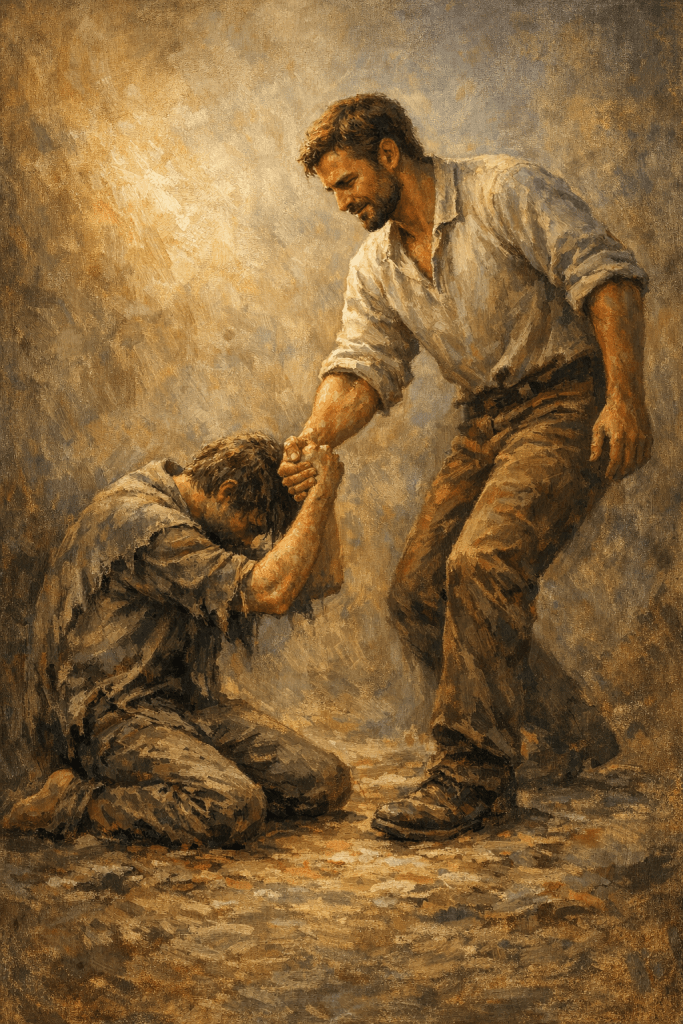
There is both a weak kindness and a strong kindness. The weak kindness is based on fear. It is where one allows oneself to be consumed by another, or by the masses. This individual gives others exactly what they want to have and tells them exactly what they want to hear. The individual does this because he is afraid of being rejected and left alone. His integrity is secondary to being accepted.
The strong kindness, on the other hand, is only possible when one is firmly his own self, deeply rooted, and full of integrity. Such a one knows his standards, and does not violate them for another, but he will give of himself when it is aligned with his principles. Thus, this person gives “kindness” on his own terms, and when he does so by sharing a part of his own self. It is a sacrifice made not by compulsion, but with true compassion and altruistic motives.
The weak kindness satiates in the moment, but it reinforces bad behavior and ultimately only hurts the world. Only the strong kindness helps.

Before you can receive the answer, you must accept the mystery

