If God Can Do Anything

Because I believe that God can do anything, I believe that He can make any desired miracle come true for me! But even more impressive, because He can do anything, He can also make things work out without the miracle. Indeed, it requires less faith to believe that God can change the world to match my heart, than to believe that God can change my heart to survive in spite of the world.

Believe in the bigger God. Believe in the God who can make you whole, with or without the thing you most desire.

Tended Towards Ruin

A Heavy Loss)

There was a project that I once loved very much. It was a program oriented towards connecting men with God, helping them to bring their hearts back into His light. It was small and local, humble and unpolished, but it did truly miraculous things in the lives of those who attended it. Lately, though, I’ve found myself struggling to recognize that same institution from what it has become today. At some point, after about ten years of operation, the institution became a for-profit organization, and changes started being made for the betterment of the bottom line, not for the betterment of the men it served. Several of the original founders quit, due to personal disagreement with this new direction.

This has been a heavy thing for me to come to grips with, but as I have reflected on it I’ve realized that it was always going to go something like this. The special spirit of the old program had to meet its end one way or another, because that’s just the nature of things.

Tale as Old as Time)

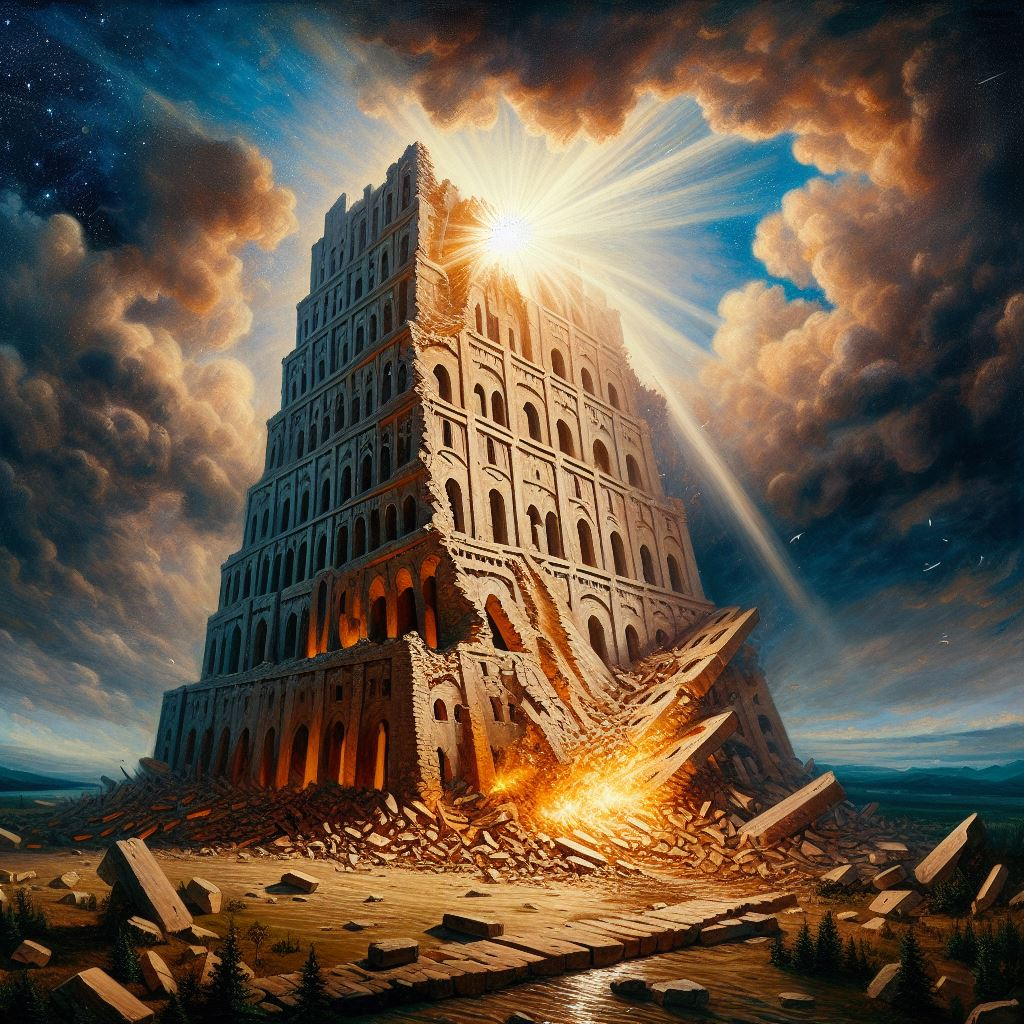
I am reminded of the story of the tower of Babel. In it, a nation of people decide to build a great tower, reaching all the way to heaven. Bold enough to make themselves gods, they toiled and labored on this great elevation of man until the whole thing toppled to the ground.

We do not know exactly how high they built their tower, only that it fell before they could achieve their aim. Their construction became destruction, their order became ruin, and the people were returned back to the level of the fallen earth.

This, of course, is a type for all manner of structures in the world today. And I don’t merely mean physical structures, either. Even more so it applies to structures of law, of government, of ideology, of any edifice constructed by the wisdom of man.

The Way of Things)

Every club, organization, corporation, and ideal is laid with ruin in its foundation. On the one hand, this might be because they are laid with carnal and earthly motivations, such as focus on profit or notoriety. Once making money is one of the organization’s pillars, then it is tied to the natural things of this earth, all of which decay, erode, and finally collapse. Through the years we have seen countless companies over-exploit their workers, consumers, and intellectual properties, killing the golden goose just to get a higher profit in the short term. We have seen countless governments siphon power and wealth to the highest class until they became too top-heavy and collapsed under their own weight. The compromises that were deemed necessary to make the enterprise possible eventually make its continued existence impossible.

But even without a foundation of earthly motivations, every structure of man is still doomed to fall due to our fundamentally flawed nature. Even our organizations that are built on ideal, and virtue, and purity of intention, gradually erode and eventually go wrong entirely. Even if a core principle is worthy, if it is taken slightly too far at the beginning, it will magnify and accelerate over time, eventually becoming a great evil. It is like stacking blocks to build a taller and taller tower, given enough time and distance every structure leans too far one way or the other. Given enough time and distance, every little flaw becomes a crushing error, and the whole thing will topple. So an organization founded with a focus on discipline will eventually become fascistic oppression, whereas a focus on liberty will eventually become gross hedonism. We sow the death even in the birth, it is simply our nature.

Even God’s church, once entrusted to earthly stewards, is tended toward ruin. The world was in a state of apostasy in the time of Noah, and in the time of Abraham, and in the time of Jesus. God has to refresh His word among His people repeatedly, not because His word has deteriorated, but because we people just keep losing our grasp of it. We know that even the believers today will once again be on the brink of ruin when God will have to refresh everything with the second coming.

What Lasts)

Ironically, what truly lasts is what seems most transient. Though man’s works are doomed to fail, along the way they house occasional sparks of something pure and genuine. There can be a nugget of God in the midst of all the stone. And though that nugget seems momentary and transient, it is only because we are perceiving it through a shifting lens. In actuality, each of those nuggets is anchored in something realer and truer than the structure it was found within.

There is an entity behind all those sparks, a constant certainty beneath every brief wonder. By fastening ourselves to these pearls, and following their threads to deeper things, we tie ourselves to the only thing that is actually eternal.

The man-made program I once loved may be gone, but the experiences I found within it have not. Those experiences introduced me to the One who hasn’t changed at all, and never will. In reality, I haven’t lost a thing.
Called to Wait

I have been guilty of being frustrated when God does not immediately answer the good desires of my heart. If I come to Him in faith, surrender my situation to His care, and believe in His power to do what is right, then why do I not receive the desired results?

And to be clear, I don’t mean going to God and asking Him to give me fame or fortune. I mean asking Him to change my heart, to cure my selfishness and addiction, to mend my brokenness so that I can be a better person. These are clearly good things, ones that I genuinely feel are in alignment with God’s will for me, so why wouldn’t the desire to change be answered with transformation?

Recently, though, I felt this impatience rebuked as I considered the precedent that is set for us in the word of God. I do not feel the scriptures justifies my opinion that God would immediately deliver every good thing that is sought for. Rather, the Bible is full of examples of waiting, sometimes for very long periods of time, before the realization of promised blessings are fulfilled.

Think of Abraham being promised that he would be the father of a great nation, but that not coming to pass for hundreds of years. Think of Jacob having to toil for seven years to marry the woman of his dreams, only to be deceived and committing to serving another seven years for her. Think of Joseph waiting long periods as a slave in Potiphar’s house and then in prison, even though he had done no wrong. Think of Moses trying to help the Israelites, failing, and then living decades in Midian before being called to try again. Think of the Israelites, freed from Egypt, but waiting in the wilderness 40 years before they would receive the Promised Land. Think of Job being left to wallow in his afflictions for a full measure before he was restored. Finally, think of those that Christ healed, and how many of them had been held by their afflictions for years before their deliverance. For the woman with the issue of blood it was twelve years, for the man at the pool of Bethesda it was thirty-eight!

In some of these examples there was a period of waiting because the people were not ready, such as the Israelites wandering in the wilderness. In others, however, there was no personal fault, such as with Joseph, it was simply not yet the right time for his deliverance. So why could not either of these cases be the same with me? Maybe I’m not ready for my deliverance, but if I trust the Lord to prepare me eventually I will be. Or maybe I am ready, but it is not the right time according to the Lord’s wisdom, so I should rest in Him and let the better things come when they may. In either case, the fact that I have not yet been healed is not, in-and-of-itself evidence that something is going wrong. It may still be going exactly right. I might be rightly waiting in the wilderness, just where I’m supposed to be.

Scriptural Analysis- Exodus 12:31-33

31 And he called for Moses and Aaron by night, and said, Rise up, and get you forth from among my people, both ye and the children of Israel; and go, serve the Lord, as ye have said.

32 Also take your flocks and your herds, as ye have said, and be gone; and bless me also.

33 And the Egyptians were urgent upon the people, that they might send them out of the land in haste; for they said, We be all dead men.

It seems to me that Verse 31 is saying that Pharaoh did not even wait for the next morning to speak with Moses and Aaron. That he called for them by night seems to suggest it was within mere hours of discovering that his own firstborn had been slain, and also all the other firstborn of Egypt.

Pharaoh had previously declared that he and Moses would never again see each other face-to-face and Moses had agreed. So while it says that he called for Moses and Aaron, and gave them permission to take the Israelites out into the wilderness, I wonder if all this was relayed by a spokesperson, or whether Pharaoh kept his back to the prophet.

In any case, Pharaoh delivered very few words to the prophet. He only said enough to show that he was finally fully complying with the demands of the Lord. He was allowing for the men, the women, the children, the flocks and the herds to leave, the entire group with no exceptions. For the first time he was not trying to limit or compromise or go back on his word.

At the very end of his declaration he also made one small petition, “and bless me also.” This is a brief and piteous request, and I wonder if God would have granted it. However, as we will soon see, Pharaoh nullified any potential act of mercy by trying to wage war with the Israelites one last time.

For now, though, all of Egypt was united in its desire to be rid of the Israelites. It says that they were “urgent upon the people,” pushing them out in haste. Such a turn of events! Where once the Egyptians had refused to let the Israelites go, now they absolutely required it! This shows greater power in God than if He had slain every Egyptian and brought Israel out of the ruin. It is one thing to force someone to do something against their will, but it is a much more significant thing to change their will to your own.

It’s Hard to Change Your Story

It can be a hard thing to change the story we have told other people of who we are. Each of us suggests to others what our principles and priorities are, what we will and will not do, and what behavior they might expect of us. Sometimes we begin to shift who we are, though, and at that point it becomes difficult to explain to others this new emerging version of ourselves. This is true whether our change is for the worse or for the better.

For the Worse)

Let us first consider the example of a change for the worse. Suppose I am developing a bad habit, or that I’m trying to admit to a bad habit that I’ve kept a secret. In this case, then telling others about this new lifestyle of mine reveals any number of the following details about me:

  1. I was lying to people in the past.
  2. I’m ignoring my conscience to do something that I still know is wrong.
  3. I wasn’t nearly so firm in my past convictions as I pretended to be.

None of these are a pleasant thing to own up to. None of them show me in a very good light. All of them make me a fool and/or a liar. Any other principles that I still claim to maintain are now suspect, because I’ve already shown the capacity to abandon one of them. This creates a motivation to hide our vices, to let people go on thinking that we are still as saintly as they had assumed, thus adding another layer of deceit to our story.

For the Better)

Now let us examine the example of me giving up a bad habit, changing my life for the better. In this case, there is still a friction against changing my story. For one, I might have the sense that my present company have something over me in that they knew the old me, the worst me, the me who openly did the things I now say I don’t do. I might be worried that these people will see my new efforts as nothing more than an act, a forced performance and not my true character. They might be anchors, trying to pull me back to what they think is the “real” me, even though I am trying to reject that version.

Not only this, but if I have done these bad habits with others, they may feel judged by my rejection of that behavior. I might say that I don’t judge them for doing that which I now consider inexcusable in myself, but that is inconsistent. I am now opposed to a part of my old self that still loves on in my friends’ current selves, so in truth I am now rejecting a part of who they are.

These two factors create a pull back towards our old ways. We are motivated to undo our story rewrite.

Is Change Possible?)

Whether for the better or the worse, change implies that there something wrong and deceitful about yourself either in the past or the present. Making a change means admitting to your flawed nature, your unreliableness, and your uncertainty. Is it any wonder, then, that so few people seem to change? Some people even believe that no one can really change. They say that people can only alter their outer behaviors from time-to-time, but will still be the same person at their core.

I don’t think the situation is quite that severe, though the difficulty of true transformation should never be understated. I think it would be more accurate to say: a man really can change, even for the better, but more often than not it takes an act of God to do it!

Basis for Judgment: Assuming the Divine

Yesterday I started to speak about the difference between humanity and machines. It makes no difference to a machine whether they are used for their intended purpose or an adulterated one. Machines do not even care if they are used in such a way that destroys themselves. Machines do not have any objective truth ingrained within them.

Humanity, on the other hand, possesses all these things. It matters that we function as designed, that we do not destroy ourselves, that we are in alignment with the truth that we are built from. Misalignment in any of these categories causes frustration, depression, and culminates in real tragedy. Real hearts become broken, real potential becomes lost, real tears are shed.

Our society is taking apart its own foundation under the logic that there is no such thing as objective truth, that no principle is sacred, that every belief can be discarded without consequence. But if this is true, then by that same logic, all of the new philosophies being championed today also have no objective truth, are not sacred, and can be discarded without consequence. If you argue that Christianity has to go to make a better world, then you are conceding that there is such a thing as better, which is also to concede that there is an ideal, which would bethe end result of following every “better.” And what would the ideal be based on if not objective truth? What would the ideal be if not sacred? What would the ideal be if not undiscardable? To claim that there is a better, is to claim that there is an ultimate destination, and that must be sacred.

Of course, this isn’t to say that all traditions must be sacred, or all traditions must be superfluous. To be sure, the world does at all times and in numerous ways need to change. There really are traditions that are not aligned to truth, that are not sacred, that can be discarded. Sometimes massive overhauls have been necessary to bring mankind closer to objective truth and the ideal. All of this is true, but then these changes ought to be grounded in universal truth and the ideal. Historically, our greatest reformers understood that the only reasonable justification for change was to show that it was tied to the divinity that encompasses us all. Just look at a few key examples here in America: the founding of our nation with its basic freedoms, the abolition of slavery, and the civil rights movement. These were all based on the notion that some tradition or status quo needed to change to bring humanity closer to the universal truth that it was created from. Most of the main figures in these movements justified the new principles by showing how they were based in scripture or theology, that they were principles given by God Himself, thus showing that the change was bringing us closer to what was universally right.

Sadly, this is not the mindset that much of the social change in the western world takes today. The 1960s represent a turning point in how we have justified change and social “improvement.” Martin Luther King, Jr. was one of the last of a dying breed, a spiritual man who sought changes based on a reasonable understanding of universal truth. He is deservedly revered today, but we do not follow his example well. Even during his lifetime, a more base template for effecting change was emerging, coming into full swing as the sexual revolution. Here was a fundamental upset to the established order, based not on alignment with God, but with the self.

Things have only continued in that deplorable strain. Our society has since championed all forms of promiscuity, infidelity, sexual perversion, identity confusion, and self-worship. To accomplish this, society has cast down principles of self-control, public decency, innocence of the youth, the life of the preborn, religious tradition, responsibility and duty, and love of country. Society has not made these changes in the name of alignment to some higher power or greater truth, but by claiming that the self is the highest power and greatest truth. Man has become his own god, and in so doing, denied his connection to true divinity.

Basis for Judgment: Today’s Social Waves

Thus far I have examined the shifting beliefs and philosophies of the world, and how we tend to be changed by them over time, constraining our thoughts to certain patterns so that we stop being able to conceive of other alternatives. In my perspective, basic Christian and traditional principles are becoming progressively unfathomable to the western world.

I will be specific. Abortion, gay marriage, transgender medical procedures, euthanasia, and complete uniformity in the nature of men and women. These are the main social waves that I see taking our western world from its foundational Christian values. Some of these are firmly in opposition with Christianity, others are only at odds dependent on the degree to which they are pursued.

I believe that the media overemphasizes the conversion of the world to these agendas, presenting these as closed cases, when the battle is actually very much alive. Unfortunately, the media is the community that primarily surrounds and shapes us today, and what it presents as a decided principle tends to become the social reality soon enough.

Earlier, I discussed the parable of the Emperor’s New Clothes. Take any of the issues I mentioned above and replace the “clothes” with that philosophy. The media insists that everyone else already sees the “Emperor’s clothes”, and the individual comes to believe that everyone really does. The individual feels that there is something wrong with himself that he does not see the clothes, so he advocates for the clothes even if he does not actually see them. He describes them by simply parroting the descriptions that others have said. Most shockingly, in time he may come to truly believe that he does see them, too.

And what is the harm in all of this? Why is it at a bad thing if we as a society evolve and embrace new ideas, even if it means throwing out the theologies of old? We have discarded many antiquated beliefs, such as our superstitions, and we consider that a good and progressive thing, so why not this? Why can’t everything be cast aside if it is deemed outdated and replaced with what the masses decide is good for now?

I concede that there would not technically be any harm in this if we were merely machines changing software. To the computer, there is no difference between running its original programming or running malware. It continues happily either way, because the wires and bits have no objective truth to follow. Any failure to fulfill the purpose of their designer makes no difference to the dead material that composes the machine. Even if a virus causes the machine to run overly hard until it completely breaks itself and ceases to function at all, the machine does not care.

But mankind is not this way. Mankind is not a machine. Mankind is inseparably connected to its creator and to an objective truth, and the destruction of mankind is of great consequence. We will explore this more tomorrow.

Basis for Judgment: What Comes Out of a Man

I have discussed how we tend to be shaped by our cultures, how when most people move from one place to another, they will gradually morph from the beliefs of their old community to the beliefs of their new one. I have discussed how this occurs slowly, by osmosis, gradually constraining our perceptions and imaginations until we cannot conceive of other alternatives, and the only sensible way of living seems to be the one that we currently follow.

Of course, one does not have to move to change their perceptions. The places that we live are themselves of a transient nature. Through years and generations, new philosophies arise in the same place, and what once felt like home now feels strange and unfamiliar. Here again, most people will adapt to the new norm, which is a problem if the new norm is perverse or built on lies. Without even knowing it, the general populace will gradually defile themselves, inhaling the polluted social air until it fills them.

This brings to mind a saying from Jesus: “Not that which goeth into the mouth defileth a man; but that which cometh out of the mouth, this defileth a man” (Matthew 15:11). In this I read that it is inevitable for us to be surrounded by the corrupt philosophies of the world. We are going to consume bad thoughts and bad ideas in our daily life, and that’s unavoidable. But that does not have to mean that we, ourselves, must also be corrupted. Where we should be concerned is when we start to hear those false perspectives coming back out of our own mouths. Then we know that we have not only consumed, but have also been converted.

I have seen people who tend to be more resistant to this change, who hold to their convictions, even though it makes them unusual in their changing society. It is rare to keep oneself anchored when corruption permeates us as a way of life, but it is possible. At least, it is possible when one is intentional about holding to what is true. If one is idle and inattentive, they might hold out a little longer than others, but I do believe they will lose their grip eventually. Being properly anchored to what is true is something that we must practice actively.

Basis for Judgment: Constraints of Thought

Yesterday I mentioned that most people are only socially converted to their beliefs. They gradually, through osmosis, adopt the faith, the principles, and the paradigms that their society repeats to them. Perhaps even more importantly, they adopt the limitations that come with society’s beliefs.

When we hear a falsehood repeated enough times, it goes from sounding strange and offensive to familiar and comfortable. And when our mind becomes aligned with any principle, true or false, it establishes boundaries to reject any competing notions.

The Emperor’s New Clothes)

One of the great allegories for our day is the story of The Emperor’s New Clothes. It’s widely recognized as a lesson on peer pressure and vanity, but there is another important detail in it that we must not miss: the people are duped into participating in the grand lie because they have boundaries set on their minds to keep them from seeing that it is a lie.

Remember, the yarn that is spun by the swindling tailors is that the fabric can be seen only by those who are worthy. After the first servants and counselors confirm that they do see the clothing, bounds start to be laid on everyone else’s thinking. Everyone just assumes that if they cannot see what the others do, then it must be because they are unworthy. They have had blinders put on them by the social pressure of others’ claims, such that they cannot even consider the possibility that everyone else is lying. The notion doesn’t even cross their minds.

This lie by the tailors is particularly effective because it preys upon the insecurities of the villagers. “Impostor syndrome” is a common sensation that falls upon us all. None of us are so clever or so good as we would like to be, nor so much as most of us pretend to be. Everyone feels a fraud inside, and so not seeing the Emperor’s clothes, and by extension being told that they were unworthy, only confirmed what the villagers had already suspected about themselves and they didn’t even try looking for other options.

This is why it is a young boy, still innocent and with no self doubts, who is finally be able to see through the charade. The idea that he would be unworthy was the notion that could not cross his mind, and so he was able to rightly see the truth of the matter. And when he did, it was not only the king who had his nakedness exposed. Every villager now knew that his neighbor was full of self-doubt and shame, and would absolutely lie to hide it.