Those that say they will not follow God’s commandments until they are convinced that He is real overlook the fact that even the truly faithful regularly struggle to keep His commandments also. Even a strong belief in God’s reality does not suddenly cause us to swallow our appetites and live as perfect saints.
Indeed, it is our struggle with our moral behavior that leads so many of us to believe in God in the first place. Our belief in Him begins as we let go of our misplaced belief in ourselves. We try to change our hearts on our own, we consistently fail, we lose all trust in our own power, throw our last hope on a God that we are not sure of, and then experience a miracle as He changes what we never could.
Thus, the cynic’s disbelief of the Almighty and dismissal of the commandments is not due to having not explored God enough, but due to having not explored his own heart enough.
9 And Moses spake so unto the children of Israel: but they hearkened not unto Moses for anguish of spirit, and for cruel bondage.

10 And the Lord spake unto Moses, saying,

11 Go in, speak unto Pharaoh king of Egypt, that he let the children of Israel go out of his land.

12 And Moses spake before the Lord, saying, Behold, the children of Israel have not hearkened unto me; how then shall Pharaoh hear me, who am of uncircumcised lips?
I mentioned that the accounts in Exodus 6 and 7 seemed to be another telling of the same events found in chapters 3, 4, and 5. If that is the case, though, today’s verses show a great discrepancy between this and the prior account. For in Exodus 4:30-31, it stated that the Israelites believed the words of Moses, but here it states that they did not.
So perhaps these chapters are not simply a repeat of the prior ones. Perhaps God was reiterating His prior messages as a way to rekindle Moses’s belief, but when Moses tried to do the same for the Israelites they weren’t willing to accept it. Or perhaps these chapters are still a repeat of the prior ones, and one of the accounts is mistaken in this matter.
Personally, I still think that the situation is the latter, and if this second account is the more accurate one, then it would seem that the reason why Moses argued to the Lord that he wasn’t fit for his tasks was because he had failed at the very first step: convincing the Israelites to trust in God’s plan. His failure to capture the hearts of the people might have reinforced his belief he was an incapable vessel. He had similarly failed in the past to aid the Israelite people, and so his fears would have been well-founded.
And as for the Israelites, in verse 9 it tells us that they were simply too broken by their sorrows and their afflictions to accept the glad news that Moses had brought from the Lord. Their core problem was not their doubt of Moses, but their utter lack of hope. Fortunately, Aaron was apparently an Israelite who could still hope, and who had confidence in Moses’s word. He was the bridge God needed to overcome both Moses’s self-doubt and Israel’s hopelessness.
16 Now the priest of Midian had seven daughters: and they came and drew water, and filled the troughs to water their father’s flock.

17 And the shepherds came and drove them away: but Moses stood up and helped them, and watered their flock.
When Moses intervened to save the Israelite slave things hadn’t turned out so well for him. Thankfully, it would seem that the disappointment of that experience was not enough to make him lose his heroic nature. Away, in a new land, with no obligation to these strangers, he still extended himself to help them in their time of need. The record does not tell us whether he confronted the troublesome shepherds or if he simply came to help the maidens after the mischief was over. I would be very curious to know whether he was still as bold as when he slew the Egyptian guard, or if he had started to temper his responses.
In either case, Moses does reveal a nurturing quality that wasn’t recounted when he freed the Israelite slave. In that earlier moment we only heard of his moment of passion when he destroyed the oppressor, but now he is shown exemplifying compassion and care, helping to gather the women’s sheep and watering the animals for them. Ultimately Moses will be called to lead a broken people, and that is going to require much more of an investment of time and effort, not just quick, instantaneous fixes.
15 Now when Pharaoh heard this thing, he sought to slay Moses. But Moses fled from the face of Pharaoh, and dwelt in the land of Midian: and he sat down by a well.
Yesterday we read how Moses’s slaying of the Egyptian guard was spreading as a rumor throughout the land, and how he became afraid of what would follow. It turns out that his concerns were valid, for soon the Pharaoh heard what happened and sought to slay Moses.
From his interview with the two Israelite men, it did not appear that Moses’s involvement had been received well by the slaves, and obviously he had made himself an enemy of the Egyptians. Without any friend or sanctuary, he had no choice but to run for his life, leaving the land of his childhood. He travelled quite a distance, too, due southeast, past the Sinai Peninsula and over the Gulf of Aqaba, into the land of Midian.
This change of scene represents the beginning of a new chapter in Moses’s life. He had condescended from his princely station to try and help the Israelites, but he had failed miserably, and his flight into Midian seems to have closed the door on that crusade, for we are given no indication that Moses ever intended to go back and try again. And so, Moses finds himself alive, but no longer with any purpose, while Israel finds itself once again lacking a champion who will fight for it.
For the good that I would I do not: but the evil which I would not, that I do. - Romans 7:19
The universal paradox that every addict faces is the notion that they must stop acting out, but they can’t. They have tried to stop so many times before only to repeatedly let themselves down. They are overcome with a terrible sense of powerlessness, a belief that they are forever destined to do the very things that they cannot accept.
And what makes this situation even more frustrating is that part of them still insists that they really could stop. Certainly they possess the physical capability to not do the troubling behavior. None of us are physically required to do any of the things that we wish we didn’t do. It’s just that we can’t work up the self-will to control ourselves.
Except for when we do. I was once speaking to a man who received a powerful insight from his therapist. The addict had been bemoaning that he kept returning to pornography because he had no power to resist. The therapist then asked him what would happen if he was viewing pornography in his room and heard the footsteps of someone coming down the hall. Well, in that case, all of a sudden, this “powerless” man would suddenly find untold reserves of willpower as he frantically ALT-TABBED away from the offensive window! Thus, it was clear that the man could exercise the willpower to turn from his addiction, at least when sufficiently motivated by the fear of being found out!
Can’t vs Won’t)
So, what is it? We seem to be going back-and-forth as to whether the addict can suddenly stop his problematic behavior or not. After some time, I have concluded that the seeming paradox goes away just as soon as we change one, little word. Instead of saying that the addict “can’t” stop their behavior, it is far more truthful to say that they “won’t.”
Now I don’t mean “won’t” in the sense that the addict will defiantly refuse, only that the addict has presented copious amounts of evidence that when subjected to certain situations and triggers they will act out and they will not stop themself, even though they otherwise possess the desire and physical capability to reject the behavior. This is an observable, consistent pattern which we all need to come to terms with sooner or later.
The first truth that every addict must accept is that “if I am alone, by myself, under these particular circumstances…I am going to act out.” That doesn’t mean that you don’t want to resist, or that you won’t try to resist, or that you’re faking your efforts to be sober. Indeed, the defining trait of the addict is that he really, truly, sincerely does want to stop himself…but he just won’t.
The only logical conclusion is that part of the addict is holding the rest of himself as a slave. There is the part that would live soberly, but there is the other part that won’t let him.
Surrender)
This is a simple concept, but it is extremely difficult to accept. We are loathe to admit that we are not as in control of our own selves as we pretend. We say that we aren’t beholden to anyone or anything, that we are our own master, that all it takes for us to do something is to choose to do it.
But that is demonstrably false. That we are the masters of our own fate is a motivating and happy thought, but it is a complete lie. And living a lie is to remain living a pattern of life that simply cannot work. So long as you insist on this mentality of being your own master you’re going to keep living as a slave to your lusts, insisting through it all that you’re a free man.
I would like to tell you that waving the white flag and admitting that you are a slave to your appetites isn’t necessary. I have tried to find my way around this surrender myself. I have tried to deny my fundamental powerlessness. I have tried to find the external evils that forced me to do wrong against my self will.
But the simple fact of the matter is that if I live the same patterns of life that I have lived before, I will give in to my temptations again and again. Not because anyone or anything external forced me, not because I wanted to, but because I am enslaved to a tyrant of my own making. And I have to accept that fact, and then accept it again and again, anytime my ego starts to think that I can fully trust myself in the driver’s seat, only to be proven wrong yet again.
Now I do have more to say on the matter, including more hopeful messages for the addict, but first and foremost we have to come to accept this sense of powerlessness. This is the first step of any twelve-step program, to finally accept that we willnot do what we wish we would do under every circumstance. Let’s let this notion settle in for today, and then move on to next things tomorrow. I’ll see you then.
This has been a very helpful study for me. Actively striving to be more Christ-like has been a wonderful experience where I have seen found real growth and increased happiness. Many behaviors have organically improved all on their own, far more easily than I ever would have thought possible. But while there have been areas of quick growth, there have also been other areas that are far more difficult to grow in, and behaviors that have proved far more resistant to change than I had expected. And in response to those complications I have seen the rise of my old, familiar inner critic. Through this study I have found some important lessons for how to deal with these growing pains, and having this understanding has already brought me a greater sense of peace. I guess this was just another area I needed growth in! Here are the main points that stood out to me from my study.
Keep Pressing Forward)
I have never had a time where I didn’t want to improve myself, but there was a period where it was more of an idle wish than an actual intention. And even that idle wishing was incomplete, because only some flaws did I care to improve on, while others I just didn’t care about. Eventually I was woken up to my desperate need for God and a path to follow. I realized that my existence was lifeless, and would remain so unless I was actively chasing for a better me. And at that same time I realized that if I was going to give myself over to this journey, it needed to be all the way. Now I knew that I must improve myself in every area. It simply wasn’t going to cut it to overcome lust and deceit, but leave myself a guarded recluse. Nor would it do to only build meaningful relationships, but not improve the way I cared for my body. And the outcome of this is that I can take glory in the failures I experience, because it means I’m actually trying. It means I’m no longer accepting a half-lived life. Friction, after all, is not felt until one starts moving. Luke 9:62- And Jesus said unto him, No man, having put his hand to the plough, and looking back, is fit for the kingdom of God. Ephesians 5:14- Wherefore he saith, Awake thou that sleepest, and arise from the dead, and Christ shall give thee light.
Be Direct, But Kind)
One of the most surprising epiphanies that came to me through this research was that the healthy way to treat someone else when they let me down is the same way I should treat myself when I let me down. It seems such a simple concept that I’m honestly embarrassed to say that this was a revelation, but really it answered so many of my questions and frustrations. Or to put it another way, the golden rule flows both directions. Yes, I should do unto others as I would have others do unto me…but also I should do unto myself as I would have others do unto me! If I do something to let someone else down, I would not want them to scream at or hurt me. Nor would I want them to deny that it was wrong of me, either. I would hope that they could be honest about their frustration, express it without hate, give clear direction as to which of my behaviors is causing the pain, and still reassure me of their unconditional love. It takes effort to do that. It can by very hard to get into a mental state that can be so vulnerable and kind. And I am sure that there will be many who never treat me that way. But at the very least, I should. Doctrine and Covenants 121:43- Reproving betimes with sharpness, when moved upon by the Holy Ghost; and then showing forth afterwards an increase of love toward him whom thou hast reproved, lest he esteem thee to be his enemy; Galatians 6:1- Brethren, if a man be overtaken in a fault, ye which are spiritual, restore such an one in the spirit of meekness; considering thyself, lest thou also be tempted.
Ask For Help)
The final takeaway from my study was the need for surrendering. My default behavior is to believe that I have to do things myself. I am reluctant to ask for help, or to accept kindness when it is offered. Even when I was at school and didn’t understand a difficult concept, I was more likely to beat my head against the wall trying to figure out on my own instead of raising my hand and asking a question. It seems a simple logic that if I got myself into this mess, I should be able to get myself out of it. If I was able to do the behaviors that led me here, I must also be able to do the opposite behaviors to get myself back. But that just. Isn’t. True. Yes, some steps can be undone, but some make you fall down a hole that you don’t have the gear to climb out of. And it isn’t a question of if this will happen, Adam and Eve set the pattern for this Fall and each of us will follow it. We will all be down in that pit in life, in fact we’ll be there several times. So I will do my best, my absolute, genuine best. But then, as always, I will rely on grace. For there are many parts of my heart that are too deep for me to reach, and only God can change them. Psalm 55:22- Cast thy burden upon the Lord, and he shall sustain thee: he shall never suffer the righteous to be moved. 1 Corinthians 2:5- That your faith should not stand in the wisdom of men, but in the power of God. 2 Nephi 25:23- For we know that it is by grace that we are saved, after all we can do.
I am sure Satan is pleased when I do not commit to improve myself and instead accept complacency. But I also believe that he is pleased when I do make promises, but they are ones I cannot keep.
So many times I have tried to commit myself to perfection–“I will never do this thing again”–and so many times I have failed. Then I have said to myself “okay, so apparently last time wasn’t the last time…but this one has to be! So this time I’ll just have to screw up more moral resolve than before. I just have to grit my teeth and draw up more spiritual energy than last time to make this the most excellent commitment I can, one that would carry through forever!”
But then…I have slipped again. And what did I think then? Well, clearly I had to somehow find another great well of spiritual resolve within me, one even greater than the “even greater” last one…or else I obviously wouldn’t have a chance of succeeding this time either.
Over and over this pattern continued until I was all dried up. I simply could not find any more “even greater” wells of spiritual resolve. I couldn’t keep outperforming myself endlessly. So I became disheartened. I didn’t believe myself and the promises I made. It seemed that the best pledge I could come up with was meaningless, and I began to believe that I simply couldn’t improve. Other people could, but I couldn’t. I was stuck.
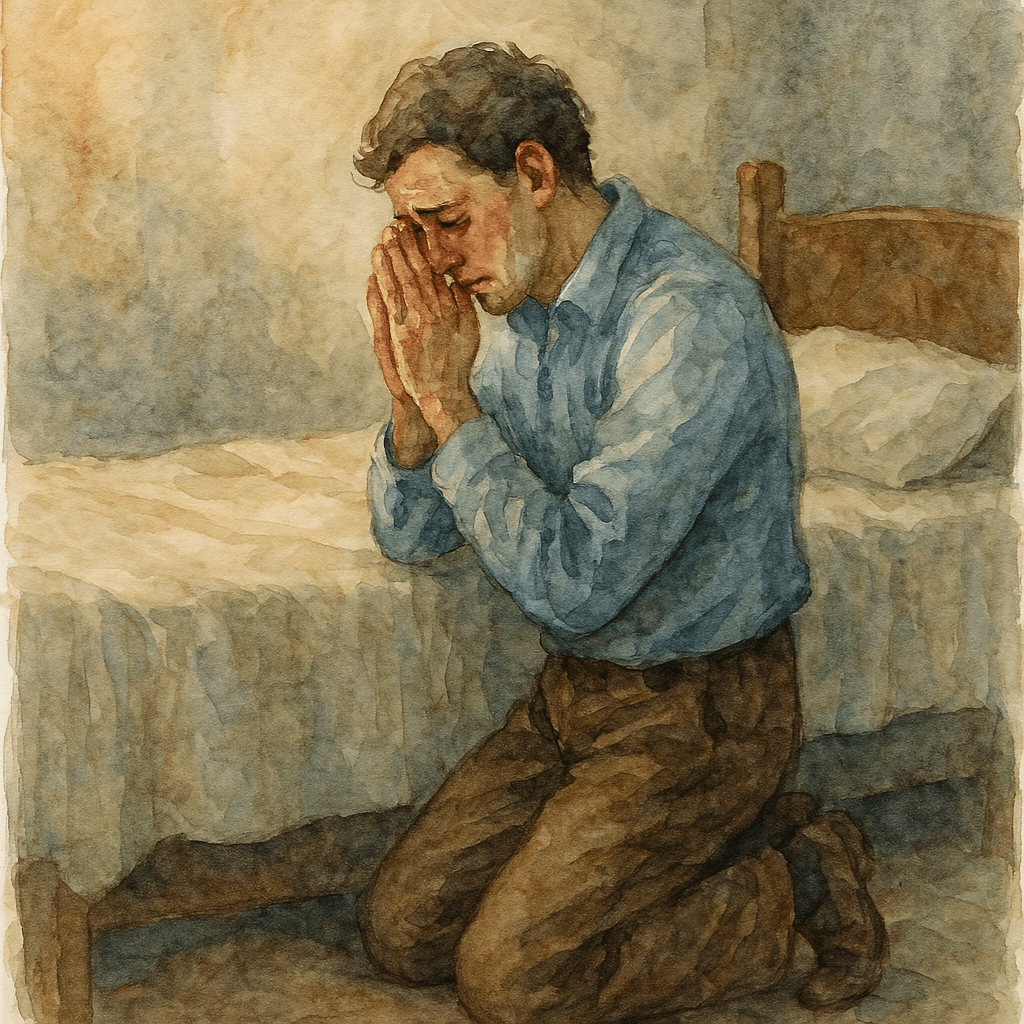
And I remained stuck until I realized there was a better way. God interrupted my spiral to show me there was an “even greatest” well that I could be making use of. One that wouldn’t ever fail me.



 Spiritual Wanderings