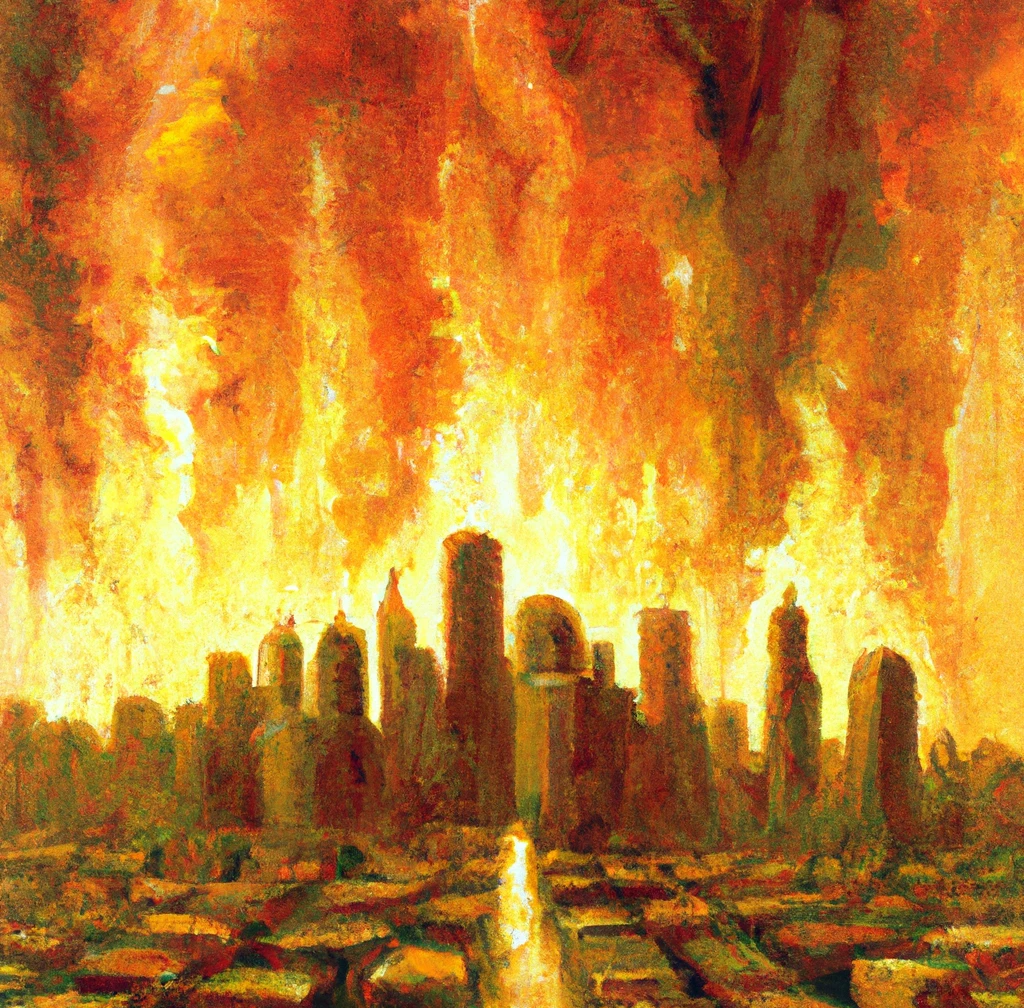
19 And the angel of God, which went before the camp of Israel, removed and went behind them; and the pillar of the cloud went from before their face, and stood behind them:
20 And it came between the camp of the Egyptians and the camp of Israel; and it was a cloud and darkness to them, but it gave light by night to these: so that the one came not near the other all the night.
The Lord had been leading Israel in a pillar of cloud by day and of fire by night. That pillar was still present when Pharaoh and his army arrived, and it moved to stand between the Israelites and the Egyptians. In later years, Isaiah would assure the Israelites that “the Lord will go before you; and the God of Israel will be your rearward” (Isaiah 52:12). Here we see that these words were not only figurative, for in this moment God had literally been both a guide ahead of Israel and a guard behind. Every promise of the Lord is fulfilled in many figurative ways, but I believe that there is always a literal realization of them as well.
Note, also, that the pillar now shifted to take on two distinct faces at the same time. It was a cloud of darkness to the Egyptians, which obscured their way forward and forced them to hold until the new day. Meanwhile, to the Israelites it was a burning fire, illuminating the way ahead as Moses worked God’s miracle upon the Red Sea and the Israelites made their escape.
Thus, once again, God was able to make a division, showing one wonder to the Egyptians and another to the Israelites. One wonder of darkness, one of light. One to hinder, one to push forward. The same God will judge, divide, and separate, like a sword cleaving good from evil.
17 And I, behold, I will harden the hearts of the Egyptians, and they shall follow them: and I will get me honour upon Pharaoh, and upon all his host, upon his chariots, and upon his horsemen.
18 And the Egyptians shall know that I am the Lord, when I have gotten me honour upon Pharaoh, upon his chariots, and upon his horsemen.
The Egyptians had already come to commit a slaughter, so why would their hearts have to be further hardened to continue with what they already intended to do? Perhaps because God was about to work another miracle in their sight, one that would pose an obvious danger. To venture into the maw of the parted sea would require a hatred or an arrogance sufficient to override the most extreme sense of self-preservation!
Only this time it was not Pharaoh’s heart alone that would harden, but that of the entire army. God meant to slay the entire horde and that could only happen if they did not mutiny and leave Pharaoh to his own devices. They all needed to charge forward as one.
This is the last instance of God being said to harden the heart of Pharaoh and his people. Frankly, it wouldn’t even concern me if in this instance He really did. At this point, Pharaoh had already shown himself willing to commit a horrible genocide, even after being given so many reasons to stand down. He was already more than worthy of death, and the God who rules over every life would be justified in guiding Pharaoh and his men to their death sentence.
Of course, there has been some speculation as to whether Pharaoh himself died in the depths of the sea. Did he lead the charge after the Israelites, or did he command from the rear, ordering his men ahead while he remained on the banks of the sea? The fact that God specifically mentions that He would “get me honour upon Pharaoh” strongly suggests that the ruler received the exact same fate as his soldiers. I think it is pretty explicit language that Pharaoh did, indeed, die in this wonder.
13 And Moses said unto the people, Fear ye not, stand still, and see the salvation of the Lord, which he will shew to you to day: for the Egyptians whom ye have seen to day, ye shall see them again no more for ever.
14 The Lord shall fight for you, and ye shall hold your peace.
15 And the Lord said unto Moses, Wherefore criest thou unto me? speak unto the children of Israel, that they go forward:
16 But lift thou up thy rod, and stretch out thine hand over the sea, and divide it: and the children of Israel shall go on dry ground through the midst of the sea.
Moses appears to have been unperturbed by the Israelites mocking, frantic questions. He assured the Israelites that they would not have to trade blows with the Egyptians, for God would battle for them. After all, hadn’t God battled for them with His plagues in the midst of Egypt? The Israelites had sat idly by while the Lord worked His wonders there, and Moses was confident that it would be the same here.
But notice that Moses first told the Israelites to “stand still,” and then the Lord corrected him, saying “Whererfore criest thou unto me? Speak unto the children of Israel, that they go forward.” Moses had been incorrect in suggesting that the Israelites should remain motionless, when actually God needed them to start moving. This suggests that until God detailed the parting of the sea in verse 16, Moses had no idea what God’s plan to save the Israelites actually was. He was sure that God would save his people, though, even if he didn’t know in what way. This reveals great faith on Moses’s part. It shows the confidence he had in the character of God, and how he rested in the certainty that the Lord would surely save them somehow.
The somehow, God revealed, was going to require more of the Israelites than standing on the banks of the sea. Back in Egypt, He had worked many wonders that required no involvement from the Israelites, but He had also worked some wonders where something was required of them, such as painting the lamb’s blood on their door posts. This next miracle was going to be of the latter category.
Moses was absolutely correct when he told the Israelites that God would fight for them and destroy their enemies, but first they had to get themselves to the place appointed for their salvation.
1 And the Lord spake unto Moses, saying,
2 Speak unto the children of Israel, that they turn and encamp before Pi-hahiroth, between Migdol and the sea, over against Baal-zephon: before it shall ye encamp by the sea.
3 For Pharaoh will say of the children of Israel, They are entangled in the land, the wilderness hath shut them in.
4 And I will harden Pharaoh’s heart, that he shall follow after them; and I will be honoured upon Pharaoh, and upon all his host; that the Egyptians may know that I am the Lord. And they did so.
Thus far, God had been leading Israel by day and by night, moving them as quickly through the land as He could. Now, though, He instructed them to stop their progress and make camp, and He deliberately instructed them to do it with their backs to the sea, thus cutting off any escape route.
God even said that this was so Pharaoh would see a moment of supposed weakness where the Israelites would be “entangled in the land.” This would tempt Pharaoh to come out with his armies and destroy them. Pharaoh would think that the Israelites had walked themselves into a trap of their own making. And indeed it was a trap, but a trap for catching Egyptians!
Thus, it was Pharaoh’s hubris that was to be his downfall. He could, of course, have left well-enough alone, but God already knew that he would not. The trap was effective because it was targeted towards Pharaoh’s character flaw: his pride and unwillingness to accept when he had lost. Due to this flaw he had already unnecessarily subjected his people to unnecessary suffering through the plagues, and now he would do so again.
Of course, verse 4 does say that God would harden Pharaoh’s heart, but I’ve already written many times that I believe this rendering is inaccurate, given the other times where it instead says that it was Pharaoh who hardened his own heart. And while this may not be the most significant of evidences, after reading today’s verses it occurs to me that another reason for believing that Pharaoh was culpable for his actions is that to assume otherwise would disrupt his character arc. Pharaoh is a type and example to us all of hubris and pride and self-defeat, but his cautionary tale would lose all its weight if he wasn’t a free agent in choosing that path of self-destruction. From a narrative perspective, it is essential that Pharaoh chose of his own free will to do evil so that the moral of his story may resonate in our hearts.
I have already reviewed the account of the Lord’s destruction of Sodom and Gomorrah in my standard scripture study, but the story has been on my mind lately and I wanted to address a few points about it in greater detail. All the verses I will be discussing can be found in Genesis 18-19.
God’s “Haggle”)
What first prompted my thoughts on this story was hearing a celebrity give it as evidence of God’s capriciousness, an example of Him being so petty and heartless that He would bargain and haggle over the lives of His children before destroying them. This is, of course, in reference to Abraham petitioning the Lord if He would spare the city for fifty souls, then forty-five, then forty, etc.
And Abraham drew near, and said, Wilt thou also destroy the righteous with the wicked?
Peradventure there be fifty righteous within the city: wilt thou also destroy and not spare the place for the fifty righteous that are therein?
So, let me first point out that these accusations are obvious falsehoods, completely misrepresenting the story as it is written. God did not haggle or bargain over how many people it would take for Him to spare the city and He never changed His position on the matter. Abraham’s position changed, but not God’s.
The first thing to note is that God never brought numbers into the matter. He simply expressed His judgment, which was to destroy the city, no numbers attached whatsoever, and it was only Abraham who brought up the idea of sparing the city if a particular number of righteous people lived there.
Abraham wanted to know whether God would have spared the city for 50 righteous, and God assures that He would have… but there just aren’t 50. Abraham wanted to know if God would have spared the city for 45 righteous, and once again God indeed would have… but there just aren’t 45. And so on and so on, until Abraham reaches his own personal limit for mercy: 10 righteous souls to spare the city.
That Abraham presses the matter no further than 10 seems to suggest that he, himself, could not condone sparing the city for any less righteous than that. Even he felt it was justified to lose nine or eight righteous, if it meant that such a terrible evil could be blotted from the earth. And, once again, God shows that His mercy extends as far as Abraham could ever hope for. God, too, would have spared the city for 10 righteous…but there just aren’t 10.
When I read the account in Genesis 18, it is not about God and Abraham haggling, it is about Abraham not yet fully trusting God, and him exploring the limits of God’s mercy until he is convinced that God’s judgment is worthy of his trust. God had pronounced judgment, but Abraham wasn’t able to trust that judgment until he was convinced that God came to that determination by due prudence and fairness, and God indulged Abraham’s tests because He wanted to earn Abraham’s trust.
Thus, there is no haggling going on in this story and no changing of God’s mind. God was simply allowing Abraham to double-check His calculations so that Abraham could begin to learn to trust the Lord’s decisions.
God’s Mercy
And, as it turns out, not only was God as prudent and merciful towards Sodom and Gomorrah as Abraham, He was even more so. For after there were not even 10 righteous in the city Abraham would have surrendered any good souls to their destruction, but God would not. God shows us in this story that He cares for even the individual righteous soul, the 1 over the 99. Thus, while He was determined to destroy the city, first He sendt two angels to draw Lot and his family out of the midst of it.
In the records we have, Abraham never beseeched the Lord for the life of his nephew, Lot, even though he knew that Lot lived in the path of destruction. Abraham seems to have been ready to let his own kin die as a justified sacrifice for this destruction of evil. It was only because God was more good than Abraham that Lot and his family were spared.
A Lesson for Abraham)
Abraham’s willingness to sacrifice the righteous for the greater good returns again later in his story. When God commanded Abraham to sacrifice Isaac, we do not see a moment of hesitation in Abraham’s response. He forthrightly makes preparation, goes to the place of sacrifice, binds his son, and raises the knife to take the lad’s life. Abraham knew that his son was good, but as with Sodom and Gomorrah, he was willing to sacrifice that good to fulfill the demands of the Lord. But then, as with Sodom and Gomorrah, God intervened to save the good and provide another way.
I wonder whether Abraham being commanded to sacrifice Isaac was, in part, a way for God to teach Abraham a lesson that He had tried to teach with Sodom and Gomorrah, but which hadn’t fully clicked yet. I wonder whether Abraham was too quick to believe in the God that would sacrifice good to destroy evil. I wonder if God temporarily assumed that role when He commanded Abraham to sacrifice Isaac, so that He could then dispel that illusion from Abraham once-and-for-all. I wonder if one of God’s lessons to Abraham in that moment was “Stop seeing me as the God of sacrifice, the God of taking, the God of destroying evil. See me as the God of saving, the God that brings back, the God of redemption!”
This is, of course, pure speculation. I don’t claim to know that this was the subtext to Abraham’s trial, or even if it’s likely. It is simply something that I wonder about. At the very least, it does stand out to me that we have no account of Abraham pleading for Lot’s life nor Isaac’s, and yet God saved them both. Whatever else those facts mean, surely they mean that these stories show God’s mercy, not wrath. They show His care, not indifference. They show His compassion, not brutishness. They show that God is a God who can be trusted when He declares His judgment because He has already analyzed the situation more than we ever could, and He cares for the innocent more than we ever would.
20 And they took their journey from Succoth, and encamped in Etham, in the edge of the wilderness.
21 And the Lord went before them by day in a pillar of a cloud, to lead them the way; and by night in a pillar of fire, to give them light; to go by day and night:
22 He took not away the pillar of the cloud by day, nor the pillar of fire by night, from before the people.
The signs and wonders had not ceased for Israel. Now they were being led by a pillar of cloud during the day and of fire during the night. The passage gives as a reason that the Israelites could “go by day and night.” The fire was apparently large enough to light their way so that they could continue walking even after the sun had gone down. Some have speculated that the pillar of cloud might have provided shade from the sun, preserving their strength as they walked through the day. It seems that God intended for them to move with great haste, carrying them swiftly towards the Promised Land.
We are also told that the Lord, Himself, “went before them” in the cloud and the fire. Note that it does not say that God was the cloud or the fire, but that He was in them, much as He had been in the burning bush when He first spoke to Moses. Thus, where God went, the cloud and fire went, and where the cloud and fire went, God’s followers went also.
All of this seems representative to me of the commandments and instructions that we receive from God. Like the pillars of cloud and fire, they stand out from the rest of the world, giving a stark contrast to the common, carnal behavior that we would otherwise follow. And while God might not be His commandments, we do say that He is in them, and that those who follow His law are also following Him. Furthermore, we believe that His instructions are guiding us through the wilderness to the ultimate Promised Land: paradise in the hereafter.
We should all consider in what ways we are following God’s pillar in our own lives. Are we truly allowing ourselves to be a peculiar and distinct people, following a different marker than the rest of the world? Are we following instructions that have been given to us by the divine? Are we true and authentic disciples? Or are we following our own opinions and conventional wisdom? Are we just “going with the flow” of the world, secularists who inappropriately claim spiritual titles? Speaking for myself, I am in a strange place somewhere in between, sometimes spiritual and sometimes secular. I still have work to do to be a follower “by day and night,” all of the time.
14 And it shall be when thy son asketh thee in time to come, saying, What is this? that thou shalt say unto him, By strength of hand the Lord brought us out from Egypt, from the house of bondage:
15 And it came to pass, when Pharaoh would hardly let us go, that the Lord slew all the firstborn in the land of Egypt, both the firstborn of man, and the firstborn of beast: therefore I sacrifice to the Lord all that openeth the matrix, being males; but all the firstborn of my children I redeem.
16 And it shall be for a token upon thine hand, and for frontlets between thine eyes: for by strength of hand the Lord brought us forth out of Egypt.
Verse 15 makes it clear that the purpose for which the firstling flocks were to be sanctified to the Lord was for sacrifice. They were not going to become the priests’ flocks, they were not going to be used by the community, they were simply being offered up as a sacrifice to God.
And what is the point of making an offering to God anyway? Why is it good for a person to destroy some of his resources, thus harming his personal status and also his society’s economy? What is the benefit in deliberately giving up a benefit?
To comprehend this paradox we must recognize that the act of sacrifice, in and of itself, naturally increases our connection to the sacred. It is good for us to take that which we have and give it away to the Lord, as doing so simultaneously debases the value of that worldly thing and elevates the value of God in our hearts. It is in our nature to respect and revere the things that we give away our resources to, as doing so signals to our minds that those things must be worth more than what we have given up. Thus, even today, while the Christian is not expected to make an animal sacrifice, he is expected pays his tithes and consecrate his time in worship services. If he does not do those things, then he is sending a signal to himself that God is not worthy of respect or reverence. What is more, he sends the same signal to his children and that sows a terrible future for them.
No wonder then that in these verses it is again made clear that the rising generation is to see and hear what sacrifices their parents are making to God and why. Again it is stressed that these rituals and traditions are to be a “token upon the hand, and for frontlets between the eyes” of the children. Their minds and their spirits are to be trained by these offerings, bringing them to have the proper estimation of God in their hearts. They are to impress upon the children just how mighty that “strength of hand that the Lord brought them out of Egypt” must have been that their parents would still mark it years afterward by offerings up every firstling of their flocks. The benefit of the sacrifice was how it would orient the children to the divine instead of the mundane.
5 And it shall be when the Lord shall bring thee into the land of the Canaanites, and the Hittites, and the Amorites, and the Hivites, and the Jebusites, which he sware unto thy fathers to give thee, a land flowing with milk and honey, that thou shalt keep this service in this month.
As I mentioned before, the Israelites who left Egypt were as far removed from Joseph as we are from William Shakespeare. Obviously, they were even further removed from Abraham, to whom God had originally promised the land of Canaan. From when God gave Abraham His promise to the birth of Isaac was a period of approximately 25 years. Isaac was 60 years old when Jacob was born, and Jacob was 130 when he entered Egypt. The Israelites dwelled in Egypt for 430 years. Thus, God’s original promise for Abraham’s seed to inherit the land of Canaan was now 645 years old when Moses led the people out of Egypt. Of course, because of some rebellion that we will soon read about, the fulfillment of the promise would be delayed another 40 years, making a wait of approximately 685 years. For comparison, 685 years before today was 1,338, at which time the Byzantine Empire was still standing!
But God had already fulfilled one of His promises to Abraham. He had made the man’s descendants into a great nation, approximately with 2 million souls, and the fulfillment of that promise was preparatory to Israel having the strength to claim the second.
No matter how much time has transpired, no matter how forgotten by man the promise might be, and no matter how many unexpected twists and turns come along the way, God will not forget or renege on His word. Many generations might pass away, but His pledge will not.
3 And Moses said unto the people, Remember this day, in which ye came out from Egypt, out of the house of bondage; for by strength of hand the Lord brought you out from this place: there shall no leavened bread be eaten.
4 This day came ye out in the month Abib.
6 Seven days thou shalt eat unleavened bread, and in the seventh day shall be a feast to the Lord.
7 Unleavened bread shall be eaten seven days; and there shall no leavened bread be seen with thee, neither shall there be leaven seen with thee in all thy quarters.
The requirements for observing the Passover had been stressed multiple times before it was observed and Israel was freed, and now on the other side of that miracle Moses doubled down on the requirements yet again. Before they left Egypt Moses pointed them forward, telling them what this observation would signify, and now that they had left Egypt Moses was pointing them backward, reminding them what the observation did signify.
This before-and-after teaching reminds me of a poetic structure that is found several places throughout the Bible called a chiasmus. In this form things are written in a palindromic way, with ideas mirroring one another as they approach the center. As it turns out, not only were Moses’s instructions palindromic, so was the very life that the Israelites were living.
They were once free in Canaan
Then they journeyed into Egypt
They were made into slaves
God worked His miracle among them
They were made free
They journeyed out of Egypt
They were on their way back to Canaan
The central pivot point between the descent and the ascent is the miracle that God worked that first Passover night. Moses repeating the instructions for the Passover both before and after the miracle further reinforces how it is the central focus of the story, and the Israelites are to align themselves to that moment moving forward. Any time in the future when they lost their way and ended up in trouble, they would be restored only by remembering the lesson that the Passover had taught to them: that God alone could save them, even if by a miracle, as they surrendered to His will.
There are a number of reasons why people break God’s commandments. Perhaps they do not believe in God, or they don’t see the importance of the commandment, or they don’t want to feel dictated in their behavior. All of these examples are a form of the person not agreeing with the commandment, so they don’t keep it.
But there is another category of commandment-breaking as well. We also break commandments that we do agree with. All of us have things where we say, “I know I shouldn’t do that…but I do it anyway. “I know I shouldn’t yell at my kids,” “I know I shouldn’t give in to my lust,” “I know I shouldn’t be so materialistic.” We can be genuinely convinced that that behavior really is wrong, yet have no plans or intention to stop it.
In these sorts of situations, I feel it is important to ask, “What is it that I am getting from this sin?” And that question should be asked sincerely. In our shame we might be tempted to respond, “Nothing, I get nothing from it, I just do it because I’m no good,” but that’s probably inaccurate. Most likely we continue with our sin because in the midst of all of the disgraceful, destructive elements of it, there is also something of value that we gain.
I know I shouldn’t yell at my kids…but it gives me an element of control.
I know I shouldn’t give in to my lust…but it soothes my loneliness.
I know I shouldn’t be so materialistic…but it motivates me to work harder.
Though we might not like giving into our vices, we’re not ready to live without the benefits that come with them. We might say that we don’t think that the ends justify the means, that the positive attribute isn’t more important to us than the negative ones, but our behavior would suggest otherwise. Part of us really does believe that the vice is the best way to get what we want, and it is terrified at the idea of living without that.
Identifying which benefit our vice provides us is the first step to being able to do something about it. Once we know what it is we are trying to get from the behavior, we can start to consider better ways that we can get it. Maybe we really do need more control in our home, or reprieve from our loneliness, or motivation to work hard. Is there another way that we can achieve that? A way that doesn’t compromise our conscience? A way that is harder, but more pure?
Hopefully so. But if not, then we still have our second option, which is to surrender the benefit to God. The fact is, we can’t always have all of the benefits that we want in our lives, at least not by moral means. Having identified exactly what that benefit is, though, allows us to be very specific when we lay it on the altar. We don’t just say, “God, I give you my will,” we say, “Here, God. I lay my desire for companionship on the altar. It seems for this chapter of life I just have to be lonely and I surrender to Your will in that. I will no longer seek to numb the pain from that loneliness by immoral behavior. I will embrace the hurt, that I may learn whatever lessons that You have for me in it. Amen.”