I’ve spent several days discussing why we should not deceive others, even when we say we are doing it for their own good. After yesterday’s post I thought I was finished with the matter, but some more thoughts have occurred to me that I would like to get down. Today I want to call out how improbable it is that our lies can be harmless in the long run, and tomorrow I will look at the matter from a more global scale.
The Arrogance of a Lie)
When we lie, we concoct a world that is in some way different from the real one. Most of us think we will get away with a “little, white lie” because we think we are concocting a world that is virtually indistinguishable from the real one. We believe that the person we deceive will still continue along the general path of reality, just with an imperceptible tint slightly coloring their view.
But that is a supremely arrogant assumption. If telling such a lie were even possible, it could only be done by having a perfect understanding of our subject and their context in life. We would have to know what they already know and believe so that our lie would not have any unintended side effects. For example, if our lie was about another person, we would want to know what our subject already thought and felt about that person in great detail, so that our deceit wouldn’t warp the relationship in any way.
We would also require a comprehensive view of our subject’s situation in life to know if our lie, seemingly harmless by itself, might unravel in terrible ways when combined with other factors. Not only this, but we would also need to be prophetic, anticipating all future states that our subject would be in, so that our lie would not become harmful in future situations.
And finally, if this is to be at all moral, we must also know that our subject, if made aware of this intended deception, would willingly choose to have it administered to them. Obviously we cannot ask them that, but we have to somehow know for certain that this is what they would choose. For even if you did believe that it was genuinely good for this person to be deceived, everyone should still have the right to embrace hard truths if that is what they choose.
Of course, none of us know all of these things when we set out to deceive another. As such, we are not at all sure whether telling them this lie is good for them or not. If we could be honest about our deceit, we would admit that it really isn’t about doing what is best for them at all. It is about what is doing what is best for ourselves. We are trying to moderate and manage another person’s experiences in a way that is more pleasant for us to deal with. It is, put simply, entirely selfish.
Gambling)
When we tell another person a lie, what we are really doing is gambling with their safety and their happiness. We are putting their heart on the line, rolling the dice, and hoping for our desired outcome. We hope that we won’t hurt the other person, we tell ourselves that that won’t happen, but we create the very real possibility that it might happen. That is our exposure, that is what is on the table to lose, and we are deliberately making a decision to accept that. And what’s more, with every lie we are stacking the odds higher and higher against the person’s happiness, but most of us still continue rolling the dice for as long as we possibly can.
Gambling with just money is morally questionable enough, certainly there can never be any justification for doing so with another person’s heart. No matter what sort of justification you might have for your lie, it should be abundantly clear that it is still immoral. Even if the odds of success were far in our favor, it would still be fundamentally immoral.
As I’ve explained above, we have nowhere near the perspective or the intelligence for even half decent odds of success. It’s impossible to know what the chances really are, but in my experience, virtually every lie gets undone eventually. The house always wins sooner or later, but we’re stupid and arrogant enough to think that we’re the ones in charge. We are totally, unjustifiably confident, and so much so that we’re betting with the most valuable commodity that we can. Is there any more obvious a recipe for failure?
I have been discussing two examples of how we try to make someone’s life better by convincing them of a fundamental lie. I have attempted to refute both examples, and to illustrate how each ultimately causes further harm to the individual.
The first issue I have presented with “helpful” lies is that they disconnect the victim from reality, and if the person ever falls back to that reality by discovering the truth of the matter it causes them great pain. They have the pain of the truth now compounded with the fact that they were deceived and left to act in a way that was against their own wellbeing.
The second issue I presented is that someone lying to protect others from disagreeable notions is ironically reinforcing those same hated notions. If one has to lie to cover something unpleasant, it generates suspicion that the unpleasant thing is, in fact, the truth. Think of a suspect of a crime, giving an alibi that is proven to be false. That doesn’t necessarily mean that he committed the crime, but it definitely fosters suspicion that he has. A “protecting” lie only undermines itself in the long term.
The Human Desire)
In both of these cases there is a strong sense of lies getting in the way of the person being deceived. Let’s explore that a little bit.
When all is said and done, everyone is trying to live their lives and accomplish good things along the way. We all want to secure basic comforts, we want to belong to something greater than ourselves, and we want to achieve things that we can be proud of. And while these are simple criteria to list out, they are by no means simple or easy to accomplish! Life is genuinely difficult, and there are all manner of frustrations that naturally arise and must be overcome if we are to ever realize our deepest desires. In fact, we all need help if we’re to meet these ideals, and if someone isn’t able to help, then we at least expect them to stay out of the way!
Every distraction or confusion is an unnecessary hurdle, adding to the already difficult work of life, and a lie is certainly both distracting and confusing. By definition, a lie warps, obfuscates, or completely masks the truth. It makes the path ahead more difficult and sometimes impossible to perceive, thus increasing the chances of us stumbling along our way.
Consider that all of the offenses that we might commit against another person are, at their fundamental level, a frustration of the other person’s ability to achieve these core life desires. To kill, to steal, to abuse, to insult, to lie; all of these get in the way of life, comfort, belonging, and/or purpose. This is why these behaviors are considered antisocial. They are wrong to do because they unjustly take what matters most. Lying is often the most subtle of these aggravators, which is why we sometimes disregard it, but it still remains just as fundamentally wrong as all the other types of harm.
Self-Delusion)
In these most recent posts I have been arguing why it is wrong to set another person on a deceitful precipice, but it is also just as wrong to do it to ourselves. My core contention in this series is that we must recognize and overcome our tendencies towards self-delusion and self-minimizing.
There are hard truths that we don’t want to face, realities that we would rather pretend away, lies that we would prefer to live. And because we are the ones doing these things to ourselves, we somehow feel that it is okay. But as we’ve just discussed, living under this delusion frustrates our core desires, even when they are self-imposed. It’s never okay to stand in the way of our own dreams.
The thing about self-delusion is that only the self can choose to come out of it. Someone else can call you out on your folly, they can even stage an intervention, but none of that makes the real difference. You can hear everything that they say, you can even admit that they are right, but still go right on living detached from it all. Only you hold yourself prisoner, so only you can set yourself free.
In my last post I started considering whether it was a viable strategy to help someone live a richer, happier life by causing them to believe a falsehood. The idea was that if we can discredit this approach, then what remains is to live a life founded on the truth.
We discussed the example of a husband concealing an affair from his wife, in order to spare her the pain of it. The conclusion was that this sets her up to do things that actively work against her, undermining her own stability in life as she extends her dependence on a tenuous marriage. A key takeaway was that this foundation of a lie leaves the wife in a reality that is increasingly detached from the truth, resulting in horrible pain when, and if, she suddenly falls back to the real world.
Today I wanted to consider a new example, though, one where the parents of an adopted child lead him to believe that he is their biological son. The issue of a painful return to reality certainly applies to this case as well, we have all heard the stories of a child who only learns in their adulthood that they were adopted, and how that revelation was a terrible shock to them.
But this particular example also brings to mind another inherent danger in setting another person on a foundation of mistruth, one that must not go overlooked.
Covering a Lie With a Lie)
What is the reason why the parents wants their child to be believe he is their biological son? In virtually every case it is genuinely meant as a kindness. They want their child to feel that he is no less than any other, that he is just as valid and real a part of their family as he possibly could be. In their hearts he is the same as a biological son, so they want him to live as if that were the case.
But why does the child need to feel that he is a biological son to feel equal to one? What harm is there if he knows that he is adopted? It is because the parents know that there are those in the world that view adopted children as lesser. They know that some people would hold that fact against him and make him feel shamed for it. They want to protect him from such unkindness.
But here is the moment where the twisting of the truth turns back to bite those who would wrest it. The parents are actually perpetuating the very stigma that they refute. There is a cycle here where parents hide the adoption from the child because the world would use it against them, but one of the chief reasons why the world thinks there is something wrong with being adopted is because it is treated so secretively by parents. If the child does uncover the fact that he is adopted at some point, what does his parents’ concealing of that fact suggest to him? It implies that his adoption really was shameful, that it was a nasty, secret thing that had to be hidden. If his origin really was just as valid any other, then why was there a need to conceal it? There is nothing that marks something as an object of shame more than trying to hide it.
I do realize that parents may not want to fight that battle against society with their own child. Let someone else challenge that stigma and pave the way for accepting all children as equal. But the fact still remains that by not challenging the problem directly, they are only making it worse. So yes, the parents were entirely well-meaning, but as I have mentioned before, well-meaning intentions do not necessarily equate to moral behavior.
If the parents really feel that there is no difference between a biological child and an adopted one, then they ought to be able to openly talk about the truth of the situation and reinforce in their child that there is no need to feel ashamed about that truth. And if parents secretly do feel that there is a difference, but they don’t want to admit to that, then once again they are trying to extract happiness and meaningfulness out of a lie. They need to consider what is real and what is true, or at least what their best understanding of it is, and then they should live in accordance with it.
Thus far I have shown an example of those who live in the full light of the truth and are more fulfilled as a result, I have also demonstrated how building our science and technology on physical truths resulted in far greater accomplishments than could be achieved in any other way, and I have also illustrated the chaos that arises by accepting untruth. I have presented each of these as demonstrations of how being founded upon truth brings about greater growth and fulfillment and knowledge than any other course.
There is another way that we can strengthen the argument for living a life founded on truth, and that is by refuting its alternative. Let us consider an opposite philosophy, such as “sometimes a person will flourish more if they believe a lie.” If we can provide evidence that this is false, then that leaves as the only other option that we should live in the truth.
And this philosophy we will seek to discredit is no mere imagined thing. There really is an idea in our society that people will be happier if they don’t have to deal with certain unpleasant realities. It isn’t only suggested that they are better of living in ignorance of a truth, but that they should actively believe something that is opposite to that truth. One example is that a husband shouldn’t tell his wife about an affair, and another is that a child should be led to believe that his parents are biological, when in reality he is adopted.
We will examine both of these, and point out the damage, not comfort, that is inherent in each. Today we will cover the first example, that of whether infidelity should be concealed from a spouse.
The Fall)
The reason typically given for hiding a betrayal of marriage is that it only causes the innocent spouse to feel pain and anguish that she doesn’t deserve, better to let her remain happy with her home and family life. It is the burden of the unfaithful spouse to carry his transgression himself, not hurting those that did nothing wrong themselves. This is his penance.
There is much that is initially appealing in this line of reasoning, but it is extremely condescending to the faithful spouse, and also it sets her upon a treacherous trajectory. By the husband doing one thing, and then allowing his wife to believe that he didn’t, he has rotated her alignment away from reality, and worse, done so without her consent. Falsely aligned, the wife is now put in the awkward position where she might now be the instrument of her own continuing harm. She might willingly take on debt with her husband for a large purchase, such as a new home, only to be hurt financially when he announces his intention to divorce, and the property must be divided. She might unknowingly abet her own betrayal by encouraging a friendly relationship with the very person her husband is sleeping with, or even just by staying at home and watching the children while he goes out for another liaison. She might burn bridges with people that cast aspersions against her husband, even though they are the ones genuinely acting in her favor. She will continue to invest care and warmth in a man who can only offer shallow counterfeits in return, which means wasting more and more of her time and energy. She will lose years that might have been spent with a more faithful partner.
There are numerous ways that a deceived wife is likely to dig the foundation out from under herself, totally oblivious until the ledge she is standing upon suddenly breaks and she falls and hurts herself. When one is first told a lie there is a separation between their reality and true reality. As time continues that gap can only expand. Breaking the ledge and falling from perspective to reality is a painful experience. The higher the drop, the more injury incurred.
Even in the case that the wife never does catch on to the truth, it is still morally wrong to leave someone in danger of that fall, especially when the distance of that potential fall is growing greater with every passing day. Yes, she would be hurt by the truth, but then the wound could heal and there would be no threat of continuing harm. To instead leave the spouse in a place of constant and increasing danger is an act of criminal negligence.
Of course, most of us know that a spouse who decides to shield the other from the truth is almost certainly doing it more out of self-preservation, no matter what noble motivations they might pretend to. Yet even if we were to find a case where the intent really and truly was only to spare the heart of the betrayed spouse, good intentions alone do not make an action moral. One of the key things that makes an action moral is whether it creates good, or at least the potential for good in the life of the other. One of the key things that makes an action immoral is whether it creates evil, or even just the potential for it in the life of the other. In the long term, deception can only foster evil, not good, and so it is immoral.
I have explained the necessity of adhering to physical truths in the field of aviation. In order to overcome the forces of gravity and air resistance, great minds had to search out the realities of the physical world and build machines that would act in accordance with them. Today I’d like to consider another example of this in the world of logic. This time we won’t just consider the usefulness of truth, though, but also the chaos of untruth.
There is a concept in mathematics called propositional and predicate logic. In this system, propositions are statements of truth, such as George is Abe’s father, Steven is George’s father, and Marcus is not Abe’s brother. These are simple facts that contain a single piece of valid information. Then there are predicates, which are rules for how these propositions can be combined to reveal entirely new truths. For example, we might have a predicate that if A is the father of B, and B is the father of C, then A is the grandfather of C. Given our initial propositions, we can derive that George is Abe’s Grandfather, a fact that wasn’t in the original set of information.
This might not seem that useful, but once we expand our set of propositions and predicates to thousands of items there are literally millions of implied facts that a computer can derive from, something that our brains simply don’t have the capacity to process. Our modern-day databases are built upon this system of logic, allowing a large dataset to have its parts combined in a multitude of ways, revealing hidden patterns and trends, secrets and truths that were hiding in plain sight.
Let’s build expand on our example of a family tree to see this process more clearly. Suppose we have the following propositions and predicates (feel free to skim over these):
Propositions:
#1 George is Abe's Father
#2 Susan is George's wife
#3 Penny is Susan's daughter
#4 Penny is Abe's sibling
#5 Helen is George's sister
#6 Gabe is Marcus's father
#7 Steven is Marcus's maternal grandfather
#8 Agnes is Helen's mother
#9 Steven is Agnes's husband
#10 Howard is Susan's father
#11 Jill is Susan's mother

Predicates:
#1 If A is the father/mother of B, and B is the father of C, A is the grandfather of C
#2 If A is the father/mother of B, and B is the mother of C, A is the grandmother of C
#3 If B is a parent of A, and C is the husband/wife of B, then C is also a parent of A
#4 If A is the father/mother of B, and C is the other parent of B, then A is the mother/father
#5 If A is the father of B, and C is the mother of C, then A is B's husband and B is A's wife
#6 If A is the child of B, and C is the child of B, then A and C are siblings
#7 If A is the maternal grandfather of B, and B's mother is C, then A is the father of B
#8 If A is the sister of B, and B is the parent of C, A is the aunt of C
#9 If A is the child of B, and B is the aunt/uncle of C, A is C's cousin
#10 A cousin is not a sibling
#11 A mother is not a father
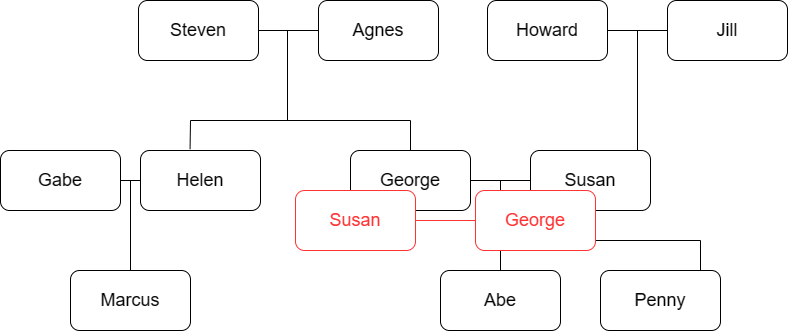
Given this setup, we could piece together the following family tree:
This tree is a visual representation of all the separate facts we get by combining all of our initial information. We can ask our system any number of questions, even ones that go beyond the scope of the original data set, and it can derive answers for them. It will answer yes, no, or uncertain, and so long as our propositions and predicates are all correct, then we can know that any derived answer is also correct. This data is a source of truth because it is based on logically sound principles.
A Twist)
But what if all of our propositions and predicates are all correct…except one? What if among all the truth facts and rules we include just one falsehood? It might occur to you that this would tarnish our confidence in the system, because there would always be a possibility that the answer it gave to us was that one lie. But actually, the effect is far, far worse. It has been proven that introducing just one logical falsehood into a system such as this will make any possible lie seem true. It won’t just be one lie that comes out of the system, it will be all lies. That might seem improbable, but allow me to illustrate.
To the system up above I will introduce one logical falsehood. Given the previously established rules, it is impossible for this to be the case, but I am going to enter it as a fact even so:
Susan is Abe's father
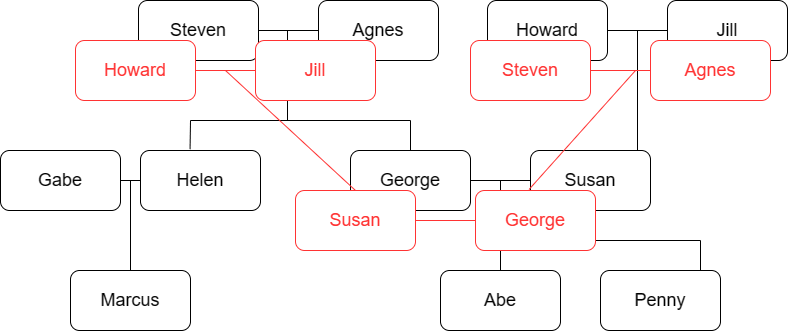
This statement is completely contrary to the logic of Predicate #11, but we add it to our system regardless. This creates a logical contradiction, and now let us look at all the new falsehoods we are able to infer from it. By Predicate #4 we can infer that since since Susan is Abe’s father, then Abe’s other parent, George, must be his mother.
Of course, we previously had derived that Steven and Agnes were Abe’s paternal grandparents, because they are George’s parents. But now that we know that George is Abe’s mother, then they must also be his maternal grandparents. By the same token, Howard and Jill are now no longer only Abe’s maternal grandparents but also his paternal.
Of course, now that we know that Howard is Abe’s paternal grandfather we can combine that with the already-known fact that Agnes is his paternal grandmother, and we can now infer that they are married together, something we never knew before! And by the same token, Steven and Jill are now also married together. Thus all the grandparents are intermarried in some sort of free-love commune! This does have the unfortunate effect of making George and Susan, Abe’s parents, siblings to one another in addition to still being husband and wife! Furthermore, since Abe’s parents are also siblings, then his sister Penny is also his cousin because her mother is the sister of Abe’s father (and her father is the brother of Abe’s mother).
But we aren’t even really going yet! We still haven’t invoked the powers of NOT and ELIMINATION. First let’s consider the NOT. Predicate #10 stated that a cousin is NOT a sibling, and Predicate #11 that a mother is NOT a father. So, since we just proved that Penny is Abe’s cousin, then she is NOT his sibling. Of course, she also is his sibling, since Proposition #4 explicitly says so. Thus, she is his sibling, and she is not. These are both totally valid answers in the eyes of our data set. And Abe’s parents George is his father and Susan is his mother, but also, they are not. And his grandparents are his grandparents, but also, they are not.
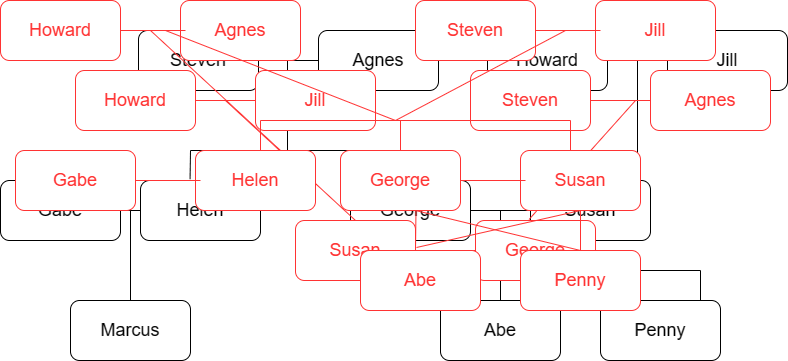
And now that we’ve shown that we can prove that the exact same relationship can and cannot exist simultaneously, by ELIMATION we can also prove that every relationship can and cannot exist. So, from the initial data set we know that Abe has a sibling. But who is it? Well, we can go through each member of his family and prove that they are not that sibling. So, let’s do that for every family member except one, Steven, and now we know, by process of elimination, that Steven must be the one who is Abe’s sibling. And by the same process we can prove by process of elimination that it is Agnes, and Howard, and Gabe, and Helen, and George, and Susan, and Marcus. And by the same process they are all his father, and all his mother, and all his aunt, and all his uncle, and all his cousin, and all his grandfather, and all his grandmother.
I’m not going to try to show the family tree at this point, because it is simply all names connected to all other names in every possible way. But also…all names connected to none of the others. Every statement is true. Every statement is false.
Our data set was useful at one point. It was full of true statements, and it could be used to infer many other true statements. But now, after a single lie the entire thing has been corrupted. The only answer it has to provide are “yes, no, maybe, I don’t know…I guess it depends on how you look at it.” It has lost all confidence and isn’t useful for anything.
And sure, this is a rigorous and mathematical system, which is particularly prone to collapsing at the slightest instability. The system in our minds is far more nuanced, able to continue functioning with illogical assumptions and idiosyncrasies…but only to an extent. The same principle does apply to us to at least some degree. Adopt the wrong belief and suddenly every other concrete conviction starts to be undermined by it. People start going through logical acrobatics to try and make incompatible beliefs fit together, corrupting all that was once good and losing the certainty they once had. We cannot accept a lie without somewhat losing our grip on all truth.
16 And she laid up his garment by her, until his lord came home.

17 And she spake unto him according to these words, saying, The Hebrew servant, which thou hast brought unto us, came in unto me to mock me:

18 And it came to pass, as I lifted up my voice and cried, that he left his garment with me, and fled out.

19 And it came to pass, when his master heard the words of his wife, which she spake unto him, saying, After this manner did thy servant to me; that his wrath was kindled.

20 And Joseph’s master took him, and put him into the prison, a place where the king’s prisoners were bound: and he was there in the prison.
The theatrics that Potiphar’s wife gets up to are laughable. She lays out Joseph’s stolen garment and waits beside it all day, so that her husband will walk in to find her still at the very scene of the crime, languishing in the throes of trauma! The pageantry is ridiculous… but it does work. Before reading today’s verses I had wondered whether Potiphar had some suspicion of what really happened. It would seem conceivable that he suspected his wife’s deceit but found it more convenient to turn out a slave than his own wife. However, in verse nineteen we read that his wrath was genuinely kindled against Joseph, suggesting that he bought into the whole charade.
Thus, Potiphar was a blind fool, manipulated by his wife into turning out the best man he had in his household. I can’t help but wonder if his wife continued with her adulterous streak, and if he ever found out about it and realized he had been played. Perhaps it is worth considering whether we have also allowed the wool to be pulled over our eyes also. Rumors that are sensational give us cathartic pleasure, and there is a temptation to believe in them simply because it is exciting to feel the powerful emotions they evoke. Indeed, some of us can become addicted to drama and gossip, holding to the ideas that are interesting, more than the ones that are actually true.
As for poor Joseph, he is out of the frying pan and into the fire! He has gone from being a free man, the son of a powerful father, to a slave, and a stranger, and now a prisoner. Here, at last, he has truly found his nadir.
13 And it came to pass, when she saw that he had left his garment in her hand, and was fled forth,

14 That she called unto the men of her house, and spake unto them, saying, See, he hath brought in an Hebrew unto us to mock us; he came in unto me to lie with me, and I cried with a loud voice:

15 And it came to pass, when he heard that I lifted up my voice and cried, that he left his garment with me, and fled, and got him out.
Potiphar’s wife could see that Joseph would never commit adultery with her, and having been frustrated in her lust she now determined to ruin him. I am struck by her language saying “he hath brought in an Hebrew unto us to mock us.” She isn’t just casting stones at Joseph, she is disparaging his entire culture. “He brought in an Hebrew” feels to me like it is spoken with revulsion, as though her husband has let a dirty thing into the house like a rat. Hebrews are untrustworthy, Hebrews are dangerous, Hebrews aren’t principled like the rest of us.
And in truth, Joseph had done nothing wrong. But a false image of him had to be erected for Potiphar’s wife to conceal her own shameful behavior. In this tactic Potiphar’s wife shows a similar mentality to that of Joseph’s brothers, who could not stand to have his worthiness reveal to them their own guilty conscience. There is a tendency among the wicked to silence their shame by smothering whatever source of purity is stinging it. Vitriolic and abusive retaliation only reveals how guilty the conscience of the crier really is.
Disagreement and difference of opinion are inevitable in life, but attempted murder and assassination of character were not proportional responses from Joseph’s brothers and Potiphar’s wife! The magnitude of their reaction shows that they did not merely disagree with Joseph, they felt threatened in their guilty souls.
32 And they sent the coat of many colours, and they brought it to their father; and said, This have we found: know now whether it be thy son’s coat or no.

33 And he knew it, and said, It is my son’s coat; an evil beast hath devoured him; Joseph is without doubt rent in pieces.

34 And Jacob rent his clothes, and put sackcloth upon his loins, and mourned for his son many days.

35 And all his sons and all his daughters rose up to comfort him; but he refused to be comforted; and he said, For I will go down into the grave unto my son mourning. Thus his father wept for him.
Joseph’s brothers wrenched his coat off his body, tore it to pieces, dipped it in blood, and then had the audacity to ask Jacob whether it was Joseph’s, as if they didn’t already know! It is interesting that the question they phrase their question as “whether it be thy son’s coat.” Could they not even bring themselves to say, “our brother’s coat?” The strange verbiage makes them sound as if they were strangers to Jacob, but then, I suppose in this moment they truly are. They are lying and pretending, presenting a face to him that is far removed from reality.
But this is not all. They then continued to lie through their teeth when they rose up to comfort their father. The very men that deprived this man of his son would then pretend to be sympathetic for his loss! Jacob thankfully rejected their overtures, even if he did not fathom what sort of vipers he had all about him.
9 And the Lord God called unto Adam, and said unto him, Where art thou?

10 And he said, I heard thy voice in the garden, and I was afraid, because I was naked; and I hid myself.

11 And he said, Who told thee that thou wast naked? Hast thou eaten of the tree, whereof I commanded thee that thou shouldest not eat?

12 And the man said, The woman whom thou gavest to be with me, she gave me of the tree, and I did eat.

13 And the Lord God said unto the woman, What is this that thou hast done? And the woman said, The serpent beguiled me, and I did eat.
Perhaps Adam and Eve hid themselves first, but I must applaud their honesty in these verses. When confronted with an inquiry they came forward and clearly confessed all that they did wrong. “I was afraid and I hid myself,” “the woman gave me, and I did eat,” “the serpent beguiled me, and I did eat.”
I do wonder whether it even occurred to them to lie. Perhaps they realized God would see through it, or perhaps no such notions had yet entered the human mind, or perhaps they were simply choosing to do what was right.
In any case, as one who has partaken of his own forbidden fruit and then lied about it, I have great respect for Adam and Eve bringing it forth directly. I am never able to move on from my shame until I am ready to confess, and the sooner I have been able to do that the better it has always been.
4 And the serpent said unto the woman, Ye shall not surely die:

5 For God doth know that in the day ye eat thereof, then your eyes shall be opened, and ye shall be as gods, knowing good and evil.
Every temptation comes with the promise of gain. Take the money and you can buy the things you want. Tell the lie and you’ll get out of trouble. View the pornography and you will have a rush of pleasure. Shout at the child and they will stop doing the thing that annoys you.
In short: eat the fruit and you will gain. And why do we give in? Because there is a truth to all of these statements. Immediate gratification does come about by committing sin. It really works!
Of course we have also been warned of painful side-effects accompanying each of these vices. After the rush of gratification comes the lack of self-respect, the shame, the addiction, the broken relationships, the decline of health, the sense of being fractured, the feeling of being cursed. And it is against these consequences that Satan lies, just as it was the consequence he was dismissive of to Eve: “Ye shall not surely die.”
When asked why we sin, most of us say it was because we thought we could get away with it, which is another way of saying we believed Satan and thought we could slip past the consequences. We thought that if we were fast enough or clever enough we could take the gratification of sin while dodging all the pain. We assumed the promised shame was only put upon us by stodgy priests and parents, and if we just didn’t care about them we wouldn’t feel bad about it. But as each of us has learned, it doesn’t really work that way. The pain is already hidden within the pleasure, you cannot bite the fruit without consuming both.





 Spiritual Wanderings