8 And thou shalt take no gift: for the gift blindeth the wise, and perverteth the words of the righteous.
This verse continues with the laws that apply to the judges themselves, telling them how they should and should not perform their duties. Today we hear that God is aware of the danger of bribes and the judges shall “take no gift,” as that will lead them to blind their judgment and pervert their decisions.
Even judges who might receive their pay from the people should not see themselves as being subject to the people. They do not act as an agent of the plaintiff or the defendant, but as an agent of truth, an agent of God, Himself. To take a gift from a witness would be to make the witness the master, and that would frustrate the entire judicial enterprise. So, if there are to be gifts and rewards for a judge, let him receive them not from man, but from God, as the natural blessings that come to those who serve well.
26 And if a man smite the eye of his servant, or the eye of his maid, that it perish; he shall let him go free for his eye’s sake.

27 And if he smite out his manservant’s tooth, or his maidservant’s tooth; he shall let him go free for his tooth’s sake.
We have some more verses of the law meant to protect a servant under his master’s care. If a master were found to have abused a servant so that the servant lost an eye or a tooth, then the servant would go free, while still retaining all of the money that was initially paid for his service. The abusive master would simply lose out on any of the six years that remained in the servant’s term.
We have already mentioned how the servanthood described here in Exodus was fundamentally different from—and morally superior to—our more modern conception of slavery. We have also discussed how this sort of paid servitude may have been necessary, given the economic state of the newly-freed Israelites, providing both an opportunity to the poor and a surety to the higher class.
But to be sure, the servants of Israel were still in a vulnerable position, and that reality is well-recognized within the law. Note that we have not seen any laws that would protect or compensate the master should he have an unproductive servant, but we have already seen multiple laws that would protect the servant should he have a cruel master. There is a common narrative in our culture that the Old Testament God was cruel and championed the oppression of the weak, but such claims are disingenuous, ignoring how His laws were deliberately tilted in the favor of the most vulnerable. The care of His heart is made manifest in the guardrails of His law.
Something I have been noticing while doing my study of Exodus is that Israel hated their enslavement in Egypt…but they also preferred it to being free. Though initially euphoric when God destroyed their enemies in the Red Sea, they repeatedly afterwards claimed that things were better for them when they were in captivity than free in the wilderness.
It seemed a strange behavior, until I examined my own life and realized that the same is true for me. As much as I may not like feeling subject to my boss, I cannot fathom living without the security he provides me. I think of all the projects I wish devoted my spare time to, but I’m afraid to cut out the movies and video games that receive most of my spare hours instead. I see my cluttered house and want to set it in order, but focus instead on the mess of emails I’m subscribed to. I say that I’m ready to live a self-controlled and honorable life, then I obey the will of my temptations instead.
From my birth I was blessed with great opportunity and freedom, given to me by the goodness of God and the sacrifices of my ancestors. But I have taken that freedom and given it right back to other masters. There is no locked gate keeping me captive, most of the prisons I have checked myself into I could leave any time that I wanted, but I choose to bind myself to these places of my own volition. I remain a prisoner because I am not ready to be truly free.
My conscience urges me to forge out into the wild. My Savior freed my soul two millennia ago. My ancestors provided the security to let my ambitions soar. I pray I find the courage to live as free as I could, to have no Master but my God, the one who calls me into deeper waters.
I have mentioned before how I lived many years under the power of an addiction to lust. Though I hated myself for it, I did things that I felt ashamed of, that I knew were wrong. I never was under the delusion that my objectification of women was an okay thing, yet I did it anyway. Because of my guilt, I would try to compensate in other areas. I would try to balance out my evil with extra kindness and devotion in my community and church.
But I never felt satisfied. In fact, I believe I was experiencing what it means to be cursed. To me this means that all of your actions, no matter how good on the surface, simply do not count. You may strive and flail, but it is as if you are running on a treadmill, all your energy leaving you in the same place. Like Cain, I tried to bring my fruits to the Lord, but He just would not accept my offering.
All of this changed, though, when I finally made confession. I told my wife what was going on in my secret life, I told my church authorities, I joined a recovery program, I went through a process of repentance, and I truly felt the atonement of Christ wash away my uncleanness.
And then I felt a sudden change. I felt the reality of God’s words to Cain: “If thou doest well, shalt thou not be accepted?” I felt the curse lifted, and now anything good that I did actually felt like it mattered.
Surrendered to Christ)
Sin is one thing that can keep our good works from reaching their full potential, but so, too, can refusing to surrender to the Lord. During my study of Pharaoh’s interactions with God and Moses, I have been thinking about this concept of surrender. Genuine surrender to the Lord is the first and fundamental basis of any true discipleship. Trying to do good while still holding back a part of your heart will always lessen the value of that good.
I know many who want to be basically good people, but who resent any notion of surrendering their will to another. In their desire to retain autonomy, to be their own master, they refuse to give themselves fully to God. They expect God to be content with the gifts that they decide to give Him, never seeking to understand what gifts He actually wants them to give. As a result, they live uninspired lives. They never experience the joy of being moved by the spirit to approach someone they normally never would have approached and saying to that person what they normally never would have said. They live according to their assumptions, not according to His genuine knowledge.
Surrendering ourselves, heart and soul to God, is necessary to be a part of His kingdom. And being part of His kingdom is necessary to having our good works sanctified for the building up of that kingdom. Trying to do good autonomously is like a swirl in an ocean, not necessarily worthless, but ultimately dissipating before it can accomplish much. Trying to do good as a pure vessel of the Lord is like being part of a flowing current, permanently and meaningfully changing the world for the better.
It is good to do good, but it is best to do the best good. And the best good can only be done by one who has repented of sin and fully surrendered to the Lord.
1 And there came two angels to Sodom at even; and Lot sat in the gate of Sodom: and Lot seeing them rose up to meet them; and he bowed himself with his face toward the ground;

2 And he said, Behold now, my lords, turn in, I pray you, into your servant’s house, and tarry all night, and wash your feet, and ye shall rise up early, and go on your ways. And they said, Nay; but we will abide in the street all night.

3 And he pressed upon them greatly; and they turned in unto him, and entered into his house; and he made them a feast, and did bake unleavened bread, and they did eat.
I never noticed this before, but the first verses of Chapter 19 are just like the first verses in Chapter 18. In Chapter 18 Abraham looked up, saw the Lord and His two companions at a distance, ran to meet them, bowed down, and invited them to his home. Here in Chapter 19 Lot looks up, sees two angels at a distance, runs to meet them, bows down, and invites them to his home.
I think what stands out to me most from these stories is that Abraham and Lot were able to recognize the holy messengers at sight. As soon as they reached them they made obeisance and asked to serve. In the next verses we will hear how the general populace of Sodom and Gomorrah reacted to the visitors, and they clearly did not recognize who these people really were. Evidently not all people can recognize angels for what they really are.
Abraham and Lot knew who their master was. We aren’t told how they could recognize the Lord and His angels, but somehow they did. I find myself wondering how good of a servant I can be if I don’t recognize my Lord, too? I cannot follow His counsel unless I recognize Him when He speaks. Are there ways that am I seeing Him right this moment, yet do not realize that it is Him?
So God created man in his own image, in the image of God created he him; male and female created he them.
And call no man your father upon the earth: for one is your Father, which is in heaven.
Henceforth I call you not servants; for the servant knoweth not what his lord doeth: but I have called you friends; for all things that I have heard of my Father I have madeknown unto you.
If I then, your Lord and Master, have washed your feet; ye also ought to wash one another’s feet.
For even the Son of man came not to be ministered unto, but to minister, and to give his life a ransom for many.
COMMENTARY
So God created man in his own image For one is your Father, which is in heaven But I have called you friends If I then, your Lord and Master, have washed your feet For even the Son of man came not to be ministered unto, but to minister Tied up with the question of who we are is the question of our relationship to divinity. For if God created us, and Christ re-creates us, then who we are depends upon the interaction that we have with them. I have heard it argued that many Christians come into trouble by trying to have the “wrong” relationship with God or Jesus. But I have heard that same argument being argued in both directions.
This generation wants to be all buddy-buddy with Jesus, and have forgotten He is their master.
The real problem is that you’re so concerned with fearing God, that you don’t have any more space for Him to love you!
You need to respect Christ, not be coddled by Him.
God’s grace is more abundant than most of us are comfortable accepting. He wants to save us, and we just need to let that in.
So which voice is correct? Who is God to us? Is He our creator or our father? Should we fear Him or worship Him? And who is Christ? A brother or a friend? A master or a servant? Well, if the verses that I’ve shared above are any indication…all of the above. Divinity represents the most transcendent and complex beings in the universe. Would not our relationship with them have to be complex and multi-faceted as well? The simple truth is that if we can only be friends with God, but never respect Him as our Lord, then our discipleship will suffer for it….And vice versa. And if we can only serve Christ, but never be served by Him, we’ll never reach that relationship’s full potential either….And vice versa. But that’s where many of us are: only comfortable with a partial connection to divinity. I was always ready to serve a Lord and Master, but struggled to accept the love of a kindly friend. The solution was not for me to try to fence off those difficult parts of God, though, that would have handicapped me for the rest of my life. The only way to progress was to start opening myself to receiving all that my God, my Father, my Savior, my brother, my master, my minister, my friend, and my advocate have to offer.
No man can serve two masters: for either he will hate the one, and love the other; or else he will hold to the one, and despise the other. Ye cannot serve God and mammon.
For let not that man think that he shall receive any thing of the Lord. A double minded man is unstable in all his ways.
COMMENTARY
No man can serve two masters A double minded man is unstable in all his ways There are many that are prepared to follow God…with caveats. Perhaps they wish to be His disciple, but still nurse a vice on the side. I myself have lived under the mindset that there was a cosmic set of scales in heaven, and I just needed to do enough good things to balance out all the bad things that I was doing, too. It is an alluring philosophy, one that would permit willful indulgences while only making token good offerings now and again. However this notion is not supported in any passage of scripture. While on my mission I met quite a few people who said of their vices: “well, like the Bible says, ‘do, but don’t overdo.'” Which quotation…flummoxed me to say the least! You can open a search engine if you don’t believe me, but nowhere does the Bible say any such thing. Obviously it is unrealistic to expect total perfection while we live in this fallen state. For sure we are going to fall short and continually depend on grace. But accepting that we need grace is not the same as condoning sin. Though this philosophy of willful indulgence may come in many different forms and compelling arguments, the source of them is always the same. There is the only being that would teach a philosophy which indulges doing things that you know are wrong. And that being does not do this to be a nice guy, his intent is strictly malicious. He is no friend of ours.
He riseth from supper, and laid aside his garments; and took a towel, and girded himself. After that he poureth water into a basin, and began to wash the disciples’ feet, and to wipe them with the towel wherewith he was girded. Then cometh he to Simon Peter: and Peter saith unto him, Lord, dost thou wash my feet? Jesus answered and said unto him, What I do thou knowest not now; but thou shalt know hereafter. Peter saith unto him, Thou shalt never wash my feet. Jesus answered him, If I wash thee not, thou hast no part with me. So after he had washed their feet, and had taken his garments, and was set down again, he said unto them, Know ye what I have done to you? Ye call me Master and Lord: and ye say well; for so I am. If I then, your Lord and Master, have washed your feet; ye also ought to wash one another’s feet. For I have given you an example, that ye should do as I have done to you. Verily, verily, I say unto you, The servant is not greater than his lord; neither he that is sent greater than he that sent him. If ye know these things, happy are ye if ye do them.
COMMENTARY
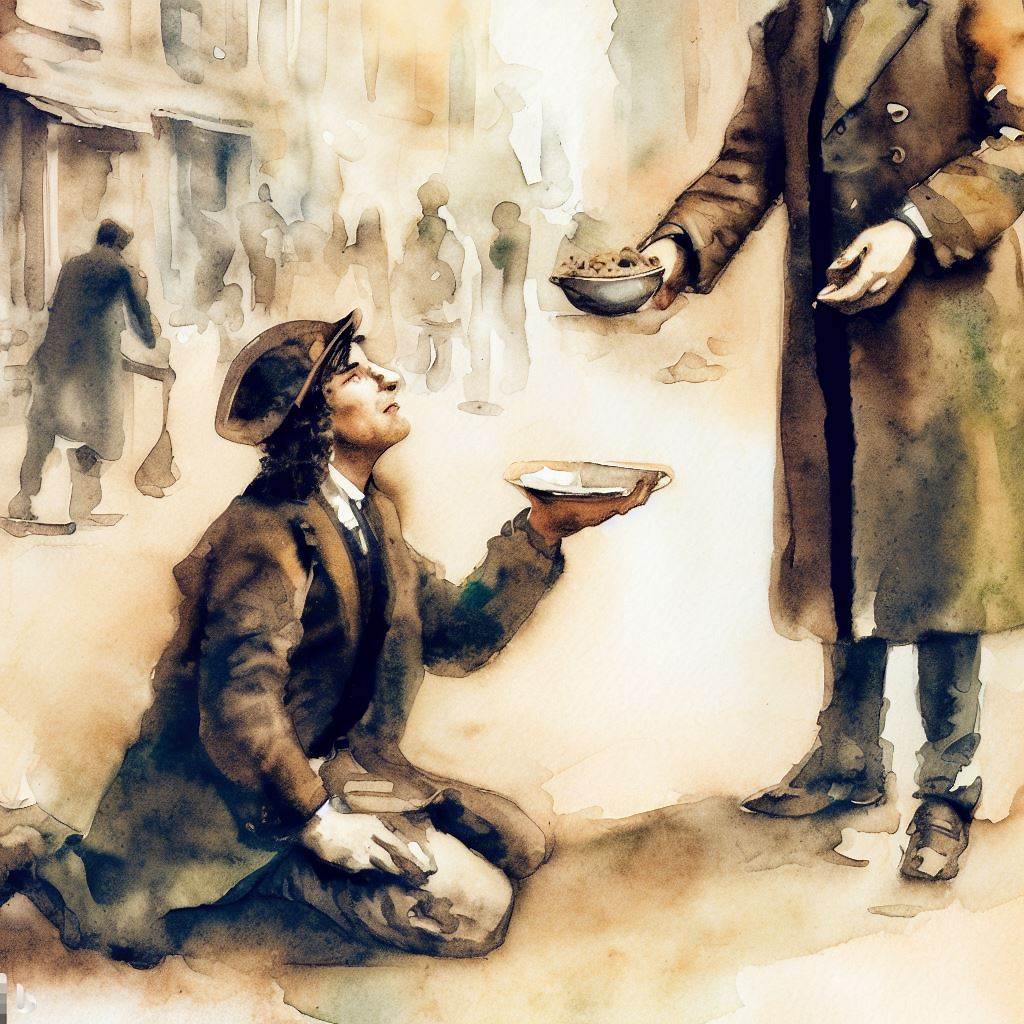
If I then, your Lord and Master, have washed your feet; ye also ought to wash one another’s feet. For I have given you an example, that ye should do as I have done to you. He who is a master has great freedom, that is obvious. Once again, the scriptures here are stressing that we are intended to use that freedom to serve others. The more power one has, the more they are expected to use that power for the good of others. The thing about being a master, though, is that there isn’t anyone else to subject you to service, you have to submit to it by your own volition. True service is something that can only be imposed on the self by the self. Most churches that I know of teach their parishioners to performs acts of service, but rarely prescribe exactly in what way or to what extent. I believe this is extremely appropriate, as otherwise it would start to feel like compelling people. After all, who made Jesus wash his disciples’ feet but himself?
Give to him that asketh thee, and from him that would borrow of thee turn not thou away. Ye have heard that it hath been said, Thou shalt love thy neighbour, and hate thine enemy. But I say unto you, Love your enemies, bless them that curse you, do good to them that hate you, and pray for them which despitefully use you, and persecute you; That ye may be the children of your Father which is in heaven: for he maketh his sun to rise on the evil and on the good, and sendeth rain on the just and on the unjust. For if ye love them which love you, what reward have ye?
COMMENTARY
For if ye love them which love you, what reward have ye? Yesterday we observed how giving charitably is to give unfairly, or in an unbalanced way. It is giving where it is not deserved. And yet God is a fair God, and so if we give excessively, then justice must demand that we receive excessively in return. Thus by giving charitably you have simultaneously blessed the life of another and also tipped the balances in your favor. Everyone is lifted together.
That ye may be the children of your Father God is the freest being we can conceive of, a personage entirely able to do as He pleases. His intention is for us to be as free as He is. The way of the world, is not this freedom. As mentioned yesterday, the way of the world is a pattern of choosing selfishly, followed by a predictable retaliation from another, followed by a predictable counter-retaliation, and so on forever. Thus begins a dance whose steps have been chosen for you. There is no freedom in this. The only way to be an actor, and not one that is acted upon, is to do something entirely unnatural and unpredictable…like loving an enemy. One must receive a wound, be entirely justified in retaliating, and instead say “no, I’ll just take it.” It is the only way to liberation.
Love your enemies, bless them that curse you, do good to them that hate you, and pray for them which despitefully use you, and persecute you One is not only made free in this manner, they are also made the most empowered. If you can only love those that love you, then they have the power to make you love them or not. They can steer your behavior by their influence. Even if they were to steer you into a rage that destroyed them, they still steered you. But if you do one of these unnatural acts of freely giving and freely forgiving, then who is in charge of your actions but yourself? To act by no other compulsion than your own, even if it is to act in subservience of another, is to be a true master.

 Spiritual Wanderings