Why Did Peter Deny Jesus?

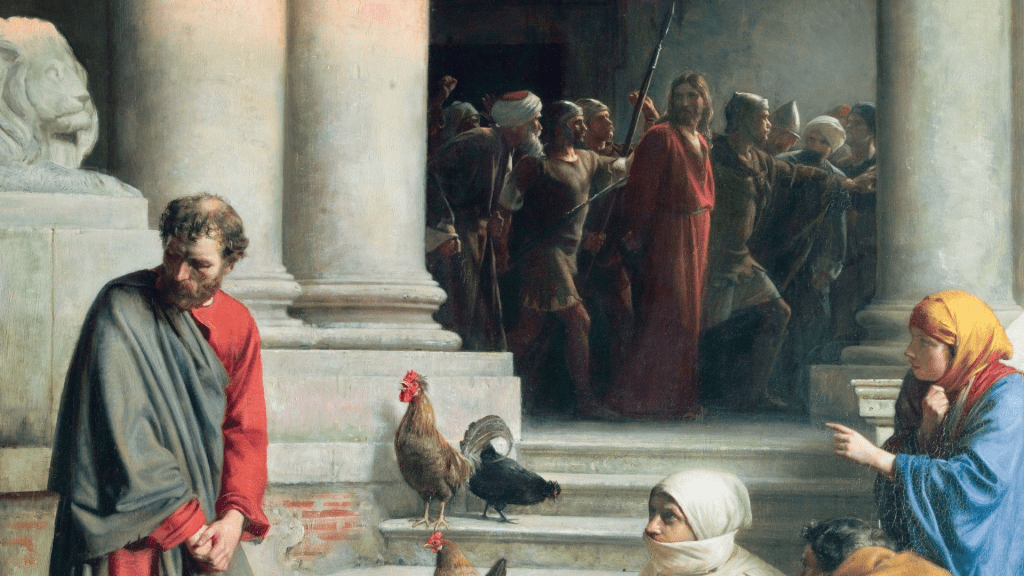
This Easter season I’ve been thinking about Jesus’s final week, culminating in his crucifixion and resurrection. One point that has stood out to me is Peter’s behavior on the night of Jesus’s arrest. Let us look at two moments from that evening:

  1. When Jesus’s captors arrive in the Garden of Gethsemane, Peter boldly leaps forward and cuts the ear off of one of them. He does this, even though Jesus and the disciples were almost certainly outnumbered and under-armed. It seems that if Jesus had not intervened, Peter’s actions would likely have gotten himself killed.
  2. After Jesus diffused the situation and surrendered to his arrest, Peter followed, waiting in the courtyard of where Jesus was being held. There he was recognized three times as one of Jesus’s followers, and each time denied it. It seems that he did this to preserve his life, to not get himself killed.

So why would Peter shrink from death in the latter case, but charge headlong toward it in the first?

I’ve always assumed that it was because Peter was acting in the heat of the moment in the first case. It may not have even crossed his mind that this could get him killed, he was just overcome with passion and acted without thinking. But during the arrest and the interrogation of Jesus, Peter had time for reality to set in, allowing him to truly feel the weight of the danger he was in, and his growing fear led him to lie.

That could certainly be the case, but as I’ve thought about it, I’ve realized that there could also be another explanation for his differing behaviors.

Another Theory)

Going back to the arrest at the Mount of Olives, what if Peter was actually fully aware that he was putting his life in jeopardy, and he was doing it deliberately? What if he was willing to sacrifice himself to give Jesus and the other disciples a chance to escape? If that were the case, then it must have been a great shock when Jesus instead rebuked him and peacefully submitted to the arrest. Jesus would have crushed the sacrifice he had been trying to make.

Now consider the second instance, where Peter lingered in the courtyard outside of Jesus’s interrogation and denied that he knew Jesus. In this case, there was no heroic rescue to be achieved by telling the truth. The only reason to admit that he was a follower of Jesus would be for the principle of the matter, to show that he would rather die than deny his master. Just because Peter might have been willing to die for some things, but not for others.

If this is the case, then Peter both proved great depth in his commitment, but also discovered even deeper depths that he was not yet ready for. He may have learned that his cause was not actually the same as Jesus’s, and that while he was prepared to die for his cause, he was not yet prepared to die for Jesus’s. He may have learned that it isn’t enough to be willing to give some sacrifice to the Lord, he needed to be willing to give the right sacrifice.

In either case, whether Peter’s initial fire cooled, or whether he was only willing to die for Jesus under certain circumstances, the tradition states that he did grow beyond his failing, that he did eventually die a martyr’s death, not on his own terms, but on the terms that were given him.

Scriptural Analysis- Exodus 40:6-8

6 And thou shalt set the altar of the burnt offering before the door of the tabernacle of the tent of the congregation.

7 And thou shalt set the laver between the tent of the congregation and the altar, and shalt put water therein.

8 And thou shalt set up the court round about, and hang up the hanging at the court gate.

We now read the order in which the courtyard is to be erected. First the sacrificial altar, then the washing basin, and finally the courtyard walls and gate. With that, all of the elements would be properly in place, though not yet anointed and ready for use.

One thing that stands out to me is that the sacrificial altar is to be placed in line with the door of the tabernacle. Not off to one side, or at a bit of an angle, but directly on the path to it. The symbolism clearly being that there is no approaching the sacred inner places without first making a sacrifice. It might seem easier if we could obtain God’s full glory before we gave up our beasts of the flesh that hold us back, but that simply isn’t how it works. The offering must come first, the presence of God must come after. For this very reason, God remains inaccessible to any who try to reverse the order and say they will only make sacrifice after they first witness God’s presence.

But for those that do make offering, the washing presents itself next. The washing comes because of the sacrifice. We are made holy and clean, and now we are ready to enter God’s glory. That is the order, and it cannot be short-circuited or rearranged. We come by that path, or we don’t come at all.

Scriptural Analysis- Exodus 29:38-41

38 Now this is that which thou shalt offer upon the altar; two lambs of the first year day by day continually.

39 The one lamb thou shalt offer in the morning; and the other lamb thou shalt offer at even:

40 And with the one lamb a tenth deal of flour mingled with the fourth part of an hin of beaten oil; and the fourth part of an hin of wine for a drink offering.

41 And the other lamb thou shalt offer at even, and shalt do thereto according to the meat offering of the morning, and according to the drink offering thereof, for a sweet savour, an offering made by fire unto the Lord.

We have heard of the sacrifices necessary to consecrate the priests and the altar, and we will hear of many more ritualistic sacrifices that would restore the Israelites back to unity with God after all manner of dividing circumstances. Today, however, we read of a constant ritual that was ongoing in perpetuity at the tabernacle. Aside from all the other offerings, there was a perpetual sacrifice being given to the Lord every day. A lamb, a measure of flour, a measure of oil, and a measure of wine every morning. A lamb, a measure of flour, a measure of oil, and a measure of wine every evening.

Many people speak of their conversion to the Lord in terms of key, pivotal moments in their lives where a specific and great sacrifice brought them into harmony with the Lord. But underlying and between these key moments there is also the constant, daily sacrifice that we make to keep ourselves on the straight-and-narrow. A man may renounce his evil ways in one, great moment of conviction, but then he must make innumerable micro-sacrifices as he turns down every following temptation to return to his old ways.

The life of the disciple is one of constant sacrifice and work, and I believe that that is what is being symbolized in these daily sacrifices. Just each individual is expected to perpetually subjugate his will to the Lord every day, so would the nation of Israel as a whole.

Scriptural Analysis- Exodus 29:22-28

22 Also thou shalt take of the ram the fat and the rump, and the fat that covereth the inwards, and the caul above the liver, and the two kidneys, and the fat that is upon them, and the right shoulder; for it is a ram of consecration:

23 And one loaf of bread, and one cake of oiled bread, and one wafer out of the basket of the unleavened bread that is before the Lord:

24 And thou shalt put all in the hands of Aaron, and in the hands of his sons; and shalt wave them for a wave offering before the Lord.

25 And thou shalt receive them of their hands, and burn them upon the altar for a burnt offering, for a sweet savour before the Lord: it is an offering made by fire unto the Lord.

26 And thou shalt take the breast of the ram of Aaron’s consecration, and wave it for a wave offering before the Lord: and it shall be thy part.

27 And thou shalt sanctify the breast of the wave offering, and the shoulder of the heave offering, which is waved, and which is heaved up, of the ram of the consecration, even of that which is for Aaron, and of that which is for his sons:

28 And it shall be Aaron’s and his sons’ by a statute for ever from the children of Israel: for it is an heave offering: and it shall be an heave offering from the children of Israel of the sacrifice of their peace offerings, even their heave offering unto the Lord.

After the sprinkling of blood, the best parts of the ram would be placed in the hands of the priest, as well as a bread, a cake, and a wafer, and they would be waved in the air. At the same time, there was also a heave offering, which is not described, but mentioned in retrospect by verse 27. The right shoulder was apparently held by the priest and heaved upward.

It also says in verse 25 that all of these items were placed upon the altar and burned for a sweet savor to the Lord, though in verses 26-28 it sounds instead like these parts were given to the priests for their allowance of food. So were the items burned on the altar, or given to the priests? I can see two possibilities:

  1. The “receive them” in verse 25 is not calling for the totality of the wave and heave offering. Perhaps only the fat, caul, and kidneys were burned upon the altar, while the breast and shoulder and breads were left for the priests.
  2. All of this first offering, which was meant for the sanctification of Aaron and his sons, was burned upon the altar, but every heave and wave offering thereafter would be given to the priests.

With either interpretation, this offering seems to be establishing the unity between God and the priest. Because the priest went through the rituals of giving up his sins, dedicating his life to the good, and receive the purification of the anointing oil and blood, now the Lord will share from His own altar with the priest. Now that the disciple has been sanctified, he is invited to share in the meal that is laid on God’s table.

Scriptural Analysis- Exodus 29:19-21

19 And thou shalt take the other ram; and Aaron and his sons shall put their hands upon the head of the ram.

20 Then shalt thou kill the ram, and take of his blood, and put it upon the tip of the right ear of Aaron, and upon the tip of the right ear of his sons, and upon the thumb of their right hand, and upon the great toe of their right foot, and sprinkle the blood upon the altar round about.

21 And thou shalt take of the blood that is upon the altar, and of the anointing oil, and sprinkle it upon Aaron, and upon his garments, and upon his sons, and upon the garments of his sons with him: and he shall be hallowed, and his garments, and his sons, and his sons’ garments with him.

Now the second ram is sacrificed. This one is neither a sin offering nor a burnt offering, but something new. The first two sacrifices took the essence of the animal and gave them to God, whereas this one has its essence directed towards the priest. This time the blood is being placed upon the ear, thumb, and toe, and then mixed with oil and sprinkled all over them. In the following verses we will learn that the meat of the ram would also be given as a meal to the priests.

It seems clear that the first two sacrifices represented what man brought as an offering to God, and now we are starting to hear what God brings back as an offering to man. With the first two sacrifices we saw represented how man must give up his sins and dedicate his life to the Lord, and now in today’s verses we see a symbol of God sacrificing his own son, Jesus Christ, that his divine blood might purge away our sins and make us holy.

No man is sufficiently pure from his efforts alone, there must also be the touch of the divine to make him truly sanctified. The sacrifices that the man makes are simply to make himself a ready receptacle to the receiving of God’s spirit, which comes as an act of grace. This is therefore a covenant, a sacred bond that goes both directions between God and man, with expectations and requirements for each.

Scriptural Analysis- Exodus 29:15-18

15 Thou shalt also take one ram; and Aaron and his sons shall put their hands upon the head of the ram.

16 And thou shalt slay the ram, and thou shalt take his blood, and sprinkle it round about upon the altar.

17 And thou shalt cut the ram in pieces, and wash the inwards of him, and his legs, and put them unto his pieces, and unto his head.

18 And thou shalt burn the whole ram upon the altar: it is a burnt offering unto the Lord: it is a sweet savour, an offering made by fire unto the Lord.

After sacrificing the bullock as a sin offering, the first ram would then be offered for a burnt offering. Here the blood was not to be smeared upon the horns of mercy, but to be sprinkled all around the altar. And instead of separating the body into key parts and handling each of them differently, instead the entire ram was burned directly on the altar, though only after it had been divided and washed.

While the sin offering seemed to do with getting rid of that which was dirty and undesirable, all of this offering is desirable, and its stated effect is to bring a sweet savor brought up to the Lord. There is something much more positive about this sort of sacrifice.

In the life of the disciple, after the sacrificing of his gross sins, what follows is the giving of his life in service to God. The proper life is defined both by the wrong things that we won’t do, and also the right things that we will do. Abstaining on the one hand, proactive on the other. The latter is what today’s offering represents. If the sin offering was the giving up of one’s life doing bad things, the burnt offering was the giving of one’s life to do good.

Scriptural Analysis- Exodus 29:10-14

10 And thou shalt cause a bullock to be brought before the tabernacle of the congregation: and Aaron and his sons shall put their hands upon the head of the bullock.

11 And thou shalt kill the bullock before the Lord, by the door of the tabernacle of the congregation.

12 And thou shalt take of the blood of the bullock, and put it upon the horns of the altar with thy finger, and pour all the blood beside the bottom of the altar.

13 And thou shalt take all the fat that covereth the inwards, and the caul that is above the liver, and the two kidneys, and the fat that is upon them, and burn them upon the altar.

14 But the flesh of the bullock, and his skin, and his dung, shalt thou burn with fire without the camp: it is a sin offering.

After being properly dressed, washed, and anointed, the priests were further prepared by sacrificial ritual. First came the bullock, which we hear in verse 14 was being offered up as a sin offering. This was for the priests to make atonement for all that they had done wrong. Like the rest of us, each of them had violated the ideal at one point or another. They had pursued self over others, they had betrayed their own consciences, they had entered misalignment with truth.

The symbolism of having the priests place their hands on the head of the bullock is clear. This placing of the hands upon the head is repeated with just about every sacrifice and is a clear representation of the animal being made to stand in place of the person. The people are choosing the animal as their representative, and witness as it receives the punishment in their place. That punishment is death, because “the wages of sin is death.”

It is worth noting, the laying on of hands is also a common practice when a disciple is ordained to a particular responsibility in the church. This makes sense, as once again that person is being selected to stand in for the other people, to make a sacrifice of his time to do the responsibilities in place of all the others.

Let us consider the meaning of what is done to the separate parts of the bullock. First, its blood is placed upon the horns of the altar. Later in the Bible we hear how the guilty would cling to these horns when seeking mercy for their wrongs, so perhaps the blood upon them represented coming to the Lord in desperation and moral anguish, casting yourself upon His mercy.

Then, the fat and the kidneys are burned upon the altars. The significance of giving the fat to the altar should be immediately clear. It was giving one’s passions, one’s indulgence, one’s reserve of energy to the Lord. No longer would the repentant give his indulgence to his carnal appetites, but to His maker.

Then, all of the bad parts: the skin and the dung, and also the very flesh of the beast, were burned without the camp. This means exiling the sin and the self, taking it out of the camp that it doesn’t belong in and destroying it. From this point on the sinner is not to be those parts anymore.

And so, atonement for sin is made. The old man of sin is destroyed, his passion and energy are dedicated to the Lord, and he casts himself upon God’s mercy. This is the same offering that we all spend our entire lives making over and over again.

Scriptural Analysis- Exodus 27:2-5

2 And thou shalt make the horns of it upon the four corners thereof: his horns shall be of the same: and thou shalt overlay it with brass.

3 And thou shalt make his pans to receive his ashes, and his shovels, and his basins, and his fleshhooks, and his firepans: all the vessels thereof thou shalt make of brass.

4 And thou shalt make for it a grate of network of brass; and upon the net shalt thou make four brasen rings in the four corners thereof.

5 And thou shalt put it under the compass of the altar beneath, that the net may be even to the midst of the altar.

Yesterday we heard the dimensions and underlying structure of the altar in the tabernacle courtyard and now we hear how it was to be overlaid and adorned. First, we are told that four horns were to be erected on its four corners. These might have been in the shape of actual horns like one might see on an animal, or perhaps they were a vague, raised shape like a pyramid or an obelisk. There is no special symbolism described for the four horns, but we hear from later passages that the guilty would sometimes go and cling to them as a way of seeking sanctuary.

All of the altar, we are told, was to be covered in brass, the same as the sockets of the outer pillars of the tabernacle. Just as gold adorned everything within the tabernacle, the less-valuable brass will be used to adorn everything in the courtyard. Of course, of all the metals brass is one of the most visually similar to gold. They both share a particular yellowish-brown color. Thus, even while making the exterior portion of the tabernacle distinct from the interior, they do still appear to be connected. So, too, our journey to God goes through multiple stages, but all of it is part of the same process.

Finally, we are told of the instruments for the altar. There are, of course, two main components to the altar.

  1. The fire burning at the bottom, for which there were to be fashioned brass shovels and firepans.
  2. The animal to be burned in that fire, for which there were to be fashioned brass basins and fleshhooks.

Finally, mediating between these two is the brass grate that was to rest halfway down the interior of the altar. The animal carcass, of course, would rest upon this as it was burned, the animal not passing down into the coals, but the heat passing up into the flesh. The grate is therefore both a separator and a unifier. It is a symbol for Christ who stands between God and man, simultaneously keeping us separate from the divine justice that would condemn us, while also bringing us in contact with the divine grace that will redeem us.

Note: It can be difficult to visualize some of the structures described in these verses. Here is an excellent and extremely focused series of animations that show the visual form of the temple and its instruments, built up verse-by-verse from the Exodus record: https://youtube.com/playlist?list=PLpjohncRg94EZ55nJrbaKfi-lfeo3MFgl&si=6wm1J9Sdnu7LKYC_

Scriptural Analysis- Exodus 27:1

1 And thou shalt make an altar of shittim wood, five cubits long, and five cubits broad; the altar shall be foursquare: and the height thereof shall be three cubits.

We have finished for the time being with the tabernacle, and now turn our attention to the outer courtyard that the tabernacle would sit within. As with the tabernacle, we start by describing the instruments and edifices that were to be placed within the courtyard, the first of which being the sacrificial altar.

In today’s verse we hear the dimensions of the altar. It is a square, five cubits by five, or 7.5 feet on each side. It is three cubits tall, or 4.5 feet, which is a pretty ideal height for laying things down to be burned. As with all the other elements of the temple, its body would be composed of shittim wood. We will hear of its overlaying and adornment in tomorrow’s verses.

This altar would, of course, be used for the offering of every large animal. Later verses, such as Exodus 29:11, seem to suggest that the animal may not have been slaughtered and prepared upon the altar, but was only burned there. Therefore, the altar is not an instrument of death, but the instrument by which that which is already dead is transformed into smoke, which is obviously a symbol of spirit. It is a place where those that have perished are consumed by the fire of God in order to be transformed to a new and better state. It is a hopeful, joyful instrument.

Note: It can be difficult to visualize some of the structures described in these verses. Here is an excellent and extremely focused series of animations that show the visual form of the temple and its instruments, built up verse-by-verse from the Exodus record: https://youtube.com/playlist?list=PLpjohncRg94EZ55nJrbaKfi-lfeo3MFgl&si=6wm1J9Sdnu7LKYC_

Scriptural Analysis- Exodus 25:8-9

8 And let them make me a sanctuary; that I may dwell among them.

9 According to all that I shew thee, after the pattern of the tabernacle, and the pattern of all the instruments thereof, even so shall ye make it.

Now we see what the offering of riches and valuables is for: to make a tabernacle for the Lord “that he may dwell among them.” If the people were willing to consecrate their very best to God, if they would show great attention in following his building instructions exactly, if they would dedicate their time and labor to building the place, then they would be able to create a sacred place where He could reside. I believe that more important than the valuables, the attention, and the effort, is the sacrifice. What would make this place worthy of God would not be the minerals or man-hours, it would be the heart and will that had been poured into it, prioritizing this cause above all other alternatives. That was what would make this place an acceptable receptacle for the Lord’s presence.

Or, at least, it would make it acceptable for the Lord’s purifying spirit to come and sanctify the place, and then that purification would be what made the place an acceptable receptacle for the Lord’s presence. See Exodus 40:34.

It is the same with our hearts also. When we perform our acts of faith, it is the faith that matters far more than the act itself. It is not what we sacrifice, but that we sacrifice. And the offerings of time and effort that we make to the Lord do not make us worthy of His name, but it does invite His spirit to come and sanctify our hearts so that then we are worthy of His name.