Scriptural Analysis- Leviticus 3:6-11

6 And if his offering for a sacrifice of peace offering unto the Lord be of the flock; male or female, he shall offer it without blemish.

7 If he offer a lamb for his offering, then shall he offer it before the Lord.

8 And he shall lay his hand upon the head of his offering, and kill it before the tabernacle of the congregation: and Aaron’s sons shall sprinkle the blood thereof round about upon the altar.

9 And he shall offer of the sacrifice of the peace offering an offering made by fire unto the Lord; the fat thereof, and the whole rump, it shall he take off hard by the backbone; and the fat that covereth the inwards, and all the fat that is upon the inwards,

10 And the two kidneys, and the fat that is upon them, which is by the flanks, and the caul above the liver, with the kidneys, it shall he take away.

11 And the priest shall burn it upon the altar: it is the food of the offering made by fire unto the Lord.

Yesterday we heard of cattle being acceptable for the peace offering, and now we read that sheep were also. Tomorrow we will hear about goats. The descriptions of how each should be offered were virtually identical to one another. One thing that is unique in today’s passages is that the sheep had to be a lamb. Neither cattle nor goats are described with that same young age requirement.

We do not have a clear explanation for this difference. Perhaps there actually was no difference, and a young animal was the expectation for all animal types. If that was the case, then either it was simply understood in that culture, or the original records were more explicit than the ones we have today.

Or, on the other hand, perhaps there really was only an age requirement for the sheep, which may have been done to help define a hierarchy of sacrifice. We saw in the last chapter that for some sacrifices fruit of the field could be an acceptable offering, but more often it was a living sacrifice. In the chapter before that, we saw how sometimes a bird could be the animal sacrificed, but more commonly it was a livestock animal. And of all the livestock, sheep were the quintessential sacrifice animal. And among sheep, obviously the lamb is the most pure and unblemished. Indeed, in some cases a lamb was the only sacrificial option, such as when the Israelites used its blood on their doorposts in Egypt to dispel the angel of death.

Thus, if there was an age requirement for sheep only, it might have been part of this hierarchy: belonging → animal → livestock → sheep → lamb. This hierarchy shows a clear progression, one that naturally draws the mind one step further, to the ultimate sacrifice, even the Lamb of God.

SacrificeEligible oblationStepsExplanation
Peace OfferingCattle, LambGratitude for reconciliation
Animal is slainGiving up old life for one of unity with another
Fat burned on altarGiving up old plans, passions, and drives

Full table.

Scriptural Analysis- Leviticus 3:2-5

2 And he shall lay his hand upon the head of his offering, and kill it at the door of the tabernacle of the congregation: and Aaron’s sons the priests shall sprinkle the blood upon the altar round about.

3 And he shall offer of the sacrifice of the peace offering an offering made by fire unto the Lord; the fat that covereth the inwards, and all the fat that is upon the inwards,

4 And the two kidneys, and the fat that is on them, which is by the flanks, and the caul above the liver, with the kidneys, it shall he take away.

5 And Aaron’s sons shall burn it on the altar upon the burnt sacrifice, which is upon the wood that is on the fire: it is an offering made by fire, of a sweet savour unto the Lord.

In the last post we discussed the difference in meaning between the Meat Offering and this Peace Offering. These different meanings are reflected in the different steps of the sacrifices, as we can see in today’s verses. For the Meat Offering, there was no death involved. The offeror merely gave some grain, or flour, or baked goods. The absence of a death would certainly help maintain the joyful levity that that offering represented. But with the Peace Offering a death was mandatory, which is much more fitting for the thoughtful and emotional themes of reconciliation to the Lord that the sacrifice represented.

The fact is that death is a necessary component for any reconciliation. It might be the death of the ego, where I finally put an end to my ideas and my behavior, letting them die, so that I can be reconciled to another. Or it might be the death of individuality, such as when a man marries a woman, and they lay to rest their solitary lives to begin a new one of unity. Certainly, it can also be the death of the Savior, who paid the ultimate price so that we can have ultimate oneness with God again.

And so, in this symbolic offering, a life is appropriately taken, and the fat of the animal, which represents its passions, its energy, and its drive, are laid on the altar and burned. The offeror gives up all these things to instead be subsumed into the Almighty.

SacrificeEligible oblationStepsExplanation
Peace OfferingCattleGratitude for reconciliation
Animal is slainGiving up old life for one of unity with another
Fat burned on altarGiving up old plans, passions, and drives

Full table.

Scriptural Analysis- Leviticus 1:14

14 And if the burnt sacrifice for his offering to the Lord be of fowls, then he shall bring his offering of turtledoves, or of young pigeons.

We already heard that the burnt sacrifice could be made with a ram or bullock, now we learn that it could also be made with a bird, either a turtledove or a pigeon. This is the first time we have heard of a bird sacrifice, so there is quite a bit to cover in how it was to be offered.

First of all, we have to acknowledge the great value disparity between a bird and the other animal types. Clearly the sacrifice of a ram or a bullock was much more substantial than a couple pigeons or turtledoves. The reason for this much cheaper option is not explained here, but it is addressed later on. “Anyone who cannot afford a lamb is to bring two doves or two young pigeons to the Lord as a penalty for their sin,” (Leviticus 5:7, NIV). Thus, if you could afford a livestock animal, you were to provide one, but so as not to make sacrifice unattainable to the poor, this other option was made available to them.

The sacrifice was therefore somewhat proportional to what you had. Like the widow with the two mites, your offering was relative to what you had. The ability to approach the Lord was meant for all of His people. So long as they were willing to come and offer something substantive to them, personally, then they could participate in all His blessings.

There is no record that suggests that there was any audit to compare the wealth of the Israelites and assign them which type of animal to bring as an offering. Perhaps it operated under a sort of honor system. You, yourself, would gauge if you had the means for a smaller or a larger sacrifice. Obviously, if anyone came to the tabernacle with a lesser sacrifice than they could afford, they would be undermining the very purpose for being there. God would know the truth of the matter, and they would be cultivating offense, not favor, with Him.

SacrificeEligible animalsStepsExplanation
Burnt offeringRam, Bullock, Pigeon, TurtledoveGiving our life to God’s purposes
Male, without blemishGive our very best
Hands placed on head, slaughteredAnimal takes the place of us
Slaughtered on the NorthRecommitment on the side of our journey
Blood sprinkled around altarOur life is sprinkled over God’s work
Cut in pieces, and washedEach part of us measured and made clean
The whole thing burned on the altarOur lives consumed in service to God

Full table.

Scriptural Analysis- Leviticus 1:3-9

3 If his offering be a burnt sacrifice of the herd, let him offer a male without blemish: he shall offer it of his own voluntary will at the door of the tabernacle of the congregation before the Lord.

4 And he shall put his hand upon the head of the burnt offering; and it shall be accepted for him to make atonement for him.

5 And he shall kill the bullock before the Lord: and the priests, Aaron’s sons, shall bring the blood, and sprinkle the blood round about upon the altar that is by the door of the tabernacle of the congregation.

6 And he shall flay the burnt offering, and cut it into his pieces.

7 And the sons of Aaron the priest shall put fire upon the altar, and lay the wood in order upon the fire:

8 And the priests, Aaron’s sons, shall lay the parts, the head, and the fat, in order upon the wood that is on the fire which is upon the altar:

9 But his inwards and his legs shall he wash in water: and the priest shall burn all on the altar, to be a burnt sacrifice, an offering made by fire, of a sweet savour unto the Lord.

The first sacrifice described in Leviticus is a burnt offering. We heard about this kind of offering in the second half of Exodus. The description given here largely follows the pattern of that earlier record, though it provides a few new details.

First, we now know that a bullock was also an acceptable animal for the burnt offering, previously we only knew of a ram. Secondly, we learned that the offering must be an unblemished male. The significance of being unblemished is clear, one was to offer to God from the very best of his flocks.

As for being male, obviously one healthy male is able to impregnate many healthy females. Many shepherds might even have a couple dozen females for each one male. The other males would be destined for slaughter or sold as beasts of burden. Thus, to offer a male is to offer your root of life, or your personal food, or your strength of labor. Excellent symbols for the burnt sacrifice, which stood for committing one’s life and efforts to God.

I have updated our table of sacrifices with this new information, marking the new portions in bold. I have realized that this table will probably get quite large, so I will only post the most relevant portion of it here in these daily posts, but the entire table can be viewed at any time over here.

SacrificeEligible animalsStepsExplanation
Burnt offeringRam, BullockGiving our life to God’s purposes
Male, without blemishGive our very best
Hands placed on head, slaughteredAnimal takes the place of us
Blood sprinkled around altarOur life is sprinkled over God’s work
Cut in pieces, and washedEach part of us measured and made clean
The whole thing burned on the altarOur lives consumed in service to God

Scriptural Analysis- Leviticus 1:1-2

1 And the Lord called unto Moses, and spake unto him out of the tabernacle of the congregation, saying,

2 Speak unto the children of Israel, and say unto them, If any man of you bring an offering unto the Lord, ye shall bring your offering of the cattle, even of the herd, and of the flock.

There are quite a few offerings described in the Bible, and their symbolism and meaning can be cryptic in our modern culture. But we already saw three types of offerings at the end of Exodus and were able to find some insights on the symbolism there. If you need a refresher, here are links to each offering that was discussed:

Sin offering
Burnt offering
Consecration offering, part one
Consecration offering, part two
Daily offering

With so many offerings, it can be hard to keep separate in the mind all their different parts and purposes. Thus, as an aid to our study, I am introducing a table that we will fill out as we go, providing a clear record of each sacrifice, the rituals surrounding it, and the possible meanings that each of those might have. Hopefully this will allow us to see any repeating patterns, and to build up the grammar of sacrifice.

For now, I will populate the table with the sacrifices we already saw at the end of Exodus, then we will expand upon it with the information gained in tomorrow’s verses.

SacrificeEligible animalsStepsExplanation
Sin offeringBullockSacrifice of sin
Hands placed on head, slaughteredAnimal takes the place of us
Blood placed on horns of the altarA heartfelt plea to the Lord for mercy
Fat and kidneys burned on altarCleansing our behavior and desire
Skin, dung, and flesh burned beyond the campThe sinful behavior purged out of us
Burnt offeringRamGiving our life to God’s purposes
Hands placed on head, slaughteredAnimal takes the place of us
Blood sprinkled around altarOur life is sprinkled over God’s work
Cut in pieces, and washedEach part of us measured and made clean
The whole thing burned on the altarOur lives consumed in service to God
Consecration offeringRamGod and the priests sharing His portion
Hands placed on head, slaughteredAnimal takes the place of us
Blood placed on tip of ear, thumb, and toeReceiving the word, work, and path of God
Blood mixed with oil and sprinkled on personGod’s spirit given to us
Wave and Heave offeringsRam, bread, oilPart of the Consecration offering
Loaves of bread and fat, kidney, shoulder, rump, and kidneys of ram waved in the air, then burnedUs participating in the work with the Lord, and Him receiving His portion of it
Shoulder and breast of ram are also waved and heaved on the shoulders, then given to us to eatUs participating in the work with the Lord, and us receiving our portion of it
Daily offeringLamb, flour, wine, oilRegular, daily renewal of all prior covenants
All parts offered on the altar, presumably burnedGiving our time, energy, and effort for regular communion and recommitment to the Lord

How to be Good Enough

You will never be enough so long as you hold part back.
You have to give your whole heart to Him,
And then you’re already enough.

Grit vs Surrender- Surrendered Autonomy

An Acceptable Offering)

In the last post we discussed how God has given to man his autonomy, but that the proper use of that autonomy is for man to then surrender it back to God. This was the example that Jesus set for us, where he had power that no man could take his life from him, and even personally desired that the cup of his sacrifice might pass from him, yet he surrendered his autonomy, submitting his will to the Father’s.

It is remarkable to me how lifelong Christians still don’t recognize the need for following this pattern in their own lives. I made this mistake myself for many years. I spent nearly three decades trying to be “good enough,” while still reserving as much autonomy as possible. I wanted to follow God, but only in my own way, and only to the extent that I was comfortable with. The rest I would hold back.

How did that work out? Not at all. I put in so much effort into trying to do so much good, but it just never felt like it was enough. I felt like I was cursed. I felt like Cain, where I made offering to the Lord, but they just weren’t being accepted. I could tell that something was missing, and I would try to fill that void with more “doing good,” but it was all in vain. What I wasn’t realizing was that it wasn’t a quantity problem, it was a quality problem.

Trying to be “good enough,” while still reserving as much autonomy as possible, is still withholding part of the heart from Jesus. And that’s a fundamental problem for us, because “the Lord looketh on the heart,” (1 Samuel 16:7). No matter how much else we put on the altar, while trying to conceal the part we won’t offer, we’re still not all His. There still remains a part of us that we don’t trust Him with, and that leaves a gulf between us that nothing else will fill.

Obsessed With Autonomy)

The western world is obsessed with autonomy. Total autonomy is actually a good thing, when it is used for a total surrender to God, but typically, that is not what we actually do. Instead, our society trains us to seize our total autonomy, and not to surrender it to anyone else, ever. Not even to God.

This only sets us up for a lifetime of always feeling insufficient and empty. We try to make ourselves fully good without giving ourselves fully to our Creator, which is only an exercise in frustration. It sets us up for a life of pushing and trying, but never actually being made better.

How great the revelation when we realize that we don’t need to worry about how to make ourselves better, we can instead let go of the ego, the need for control, and the appetites that drive us. When we let those things go, we don’t even have to make ourselves better, we just are better naturally.

Where effort only ever led to defeat, surrender is the path to victory. Where making better choices never works, capitulating all choice to God always does. Where the giving of strength never breaks shackles, the giving of the heart brings true freedom.

Grit vs Surrender- Autonomous or Not?

The Mixed Man)

Yesterday I shared about my personal struggle with addiction, and how I only found liberation as I surrendered my will to God, taking the steps that He set before me and not my own. Then, true healing and freedom blessed my life, but I want to be very clear that it did not, and never could have, come about in the way that I wanted it to. I had to do things that I didn’t want to do, but that God chose for me.

This points to an interesting paradox in the gospel. Autonomy is essential to God’s plans for us. Right from the beginning, God created a man and a woman who were designed with the capacity to make their own choices, and He even gave them a tree to exercise their choice one way or the other.

“But of the tree of the knowledge of good and evil, thou shalt not eat of it, nevertheless, thou mayest choose for thyself, for it is given unto thee,” (Moses 3:17).

If God did not mean for man to make his own choices, God never would have set things up this way.

But also, part of God’s plan is that man should surrender his will. Thus, we are all meant to have the ability to choose our own path, but to then give it up to the Father.

“Submit yourselves therefore to God,” (James 4:7).

“I beseech you therefore, brethren, by the mercies of God, that ye present your bodies a living sacrifice, holy, acceptable unto God, which is your reasonable service,” (Romans 12:1).

The Ultimate Example)

Notice how Jesus followed this pattern perfectly. His autonomy was supreme and no one else had any power over him:

“I lay down my life. No man taketh it from me, but I lay it down of myself. I have power to lay it down, and I have power to take it again,” (John 10:18).

Of course, when it actually came time to lay down his life, Jesus’s own will, his autonomy, pulled him from it. It was his desire that “this cup would pass from him.” Even so, he surrendered that autonomy, declaring to his Father, “not as I will, but as thou wilt,” (Matthew 26:39).

Tomorrow let us think some more about what this means for us personally. We will consider questions such as, how do so many of us, even Christians who fully believe the message of the Bible, fall into this false belief that we can satisfy God while holding onto our autonomy? And what does it look like to truly surrender to the will of the Lord?

Thy Sins Are Forgiven

One of the most common phrases of Jesus’s ministry was “thy sins are forgiven thee.” When the paralytic man was lowered to him through the roof, Jesus first forgave the man’s sins, then healed his body. When the woman of many sins wept on his feet and anointed them with ointment, he also told her that her many sins were forgiven. The woman taken in adultery he did not directly forgive, but he did provide her a stay of execution and implored her to sin no more, implying that he was giving her time to seek the same forgiveness that the others had received.

Even as he was dying on the cross, Jesus had two famous moments of forgiveness. He interceded for the Romans who were carrying out his execution, observing that they were acting without understanding. He also promised the repentant thief that the two of them would see each other in paradise, implicitly forgiving him of the very sins that the man was being put to death for.

These are nice moments to think on, times where Jesus gave the greatest gift that we can experience in this life. I can’t imagine reading these stories and not being moved with happiness and hope.

But I think it also worth noting the deep gravity behind them also. I think we should always remember that when Jesus said, “thy sins are forgiven thee,” that forgiveness did not pop out of nowhere. Yes, it was given freely, but it was not acquired freely. Every time Jesus uttered those words an implication followed, “thy sins are forgiven thee, because I will die for them.”

In Hebrews it states:

For where a testament is, there must also of necessity be the death of the testator.
For a testament is of force after men are dead: otherwise it is of no strength at all while the testator liveth.
Hebrews 9:16-17

Surely, part of the reason why the death of the testator, Jesus, was necessary, was because his New Testament would take the place of the death penalties in the Old Testament. Thus, when Jesus let the woman taken in adultery go free…it was only because he was going to be killed in her place. And in all the other cases where Jesus pronounced “thy sins are forgiven thee,” those were only words until he paid the price that would give them actual force. The wages of sin are death, and so forgiveness of sin could only be real after his death for them.

We rejoice whenever Jesus’s words of forgiveness, mercy, and healing come upon us, and well we should. We marvel at how freely we receive them, how they seem to come from out of nowhere. But in the midst of our joy, we should remember that the freeness of them is only an illusion from our perspective. In reality, with every word of forgiveness Jesus gives to us, he is agreeing to die for them also.

Why Did Peter Deny Jesus?

This Easter season I’ve been thinking about Jesus’s final week, culminating in his crucifixion and resurrection. One point that has stood out to me is Peter’s behavior on the night of Jesus’s arrest. Let us look at two moments from that evening:

  1. When Jesus’s captors arrive in the Garden of Gethsemane, Peter boldly leaps forward and cuts the ear off of one of them. He does this, even though Jesus and the disciples were almost certainly outnumbered and under-armed. It seems that if Jesus had not intervened, Peter’s actions would likely have gotten himself killed.
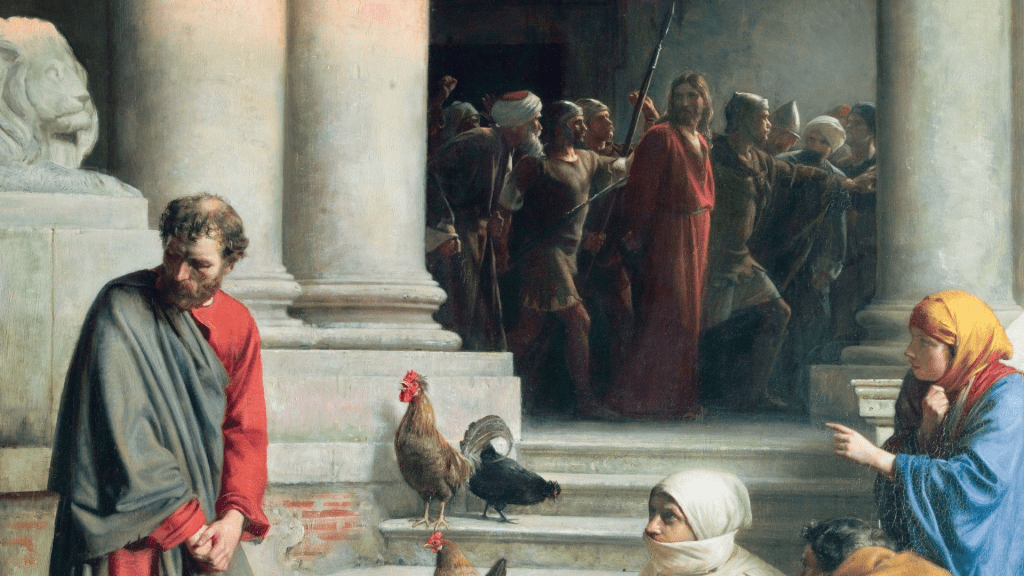
  2. After Jesus diffused the situation and surrendered to his arrest, Peter followed, waiting in the courtyard of where Jesus was being held. There he was recognized three times as one of Jesus’s followers, and each time denied it. It seems that he did this to preserve his life, to not get himself killed.

So why would Peter shrink from death in the latter case, but charge headlong toward it in the first?

I’ve always assumed that it was because Peter was acting in the heat of the moment in the first case. It may not have even crossed his mind that this could get him killed, he was just overcome with passion and acted without thinking. But during the arrest and the interrogation of Jesus, Peter had time for reality to set in, allowing him to truly feel the weight of the danger he was in, and his growing fear led him to lie.

That could certainly be the case, but as I’ve thought about it, I’ve realized that there could also be another explanation for his differing behaviors.

Another Theory)

Going back to the arrest at the Mount of Olives, what if Peter was actually fully aware that he was putting his life in jeopardy, and he was doing it deliberately? What if he was willing to sacrifice himself to give Jesus and the other disciples a chance to escape? If that were the case, then it must have been a great shock when Jesus instead rebuked him and peacefully submitted to the arrest. Jesus would have crushed the sacrifice he had been trying to make.

Now consider the second instance, where Peter lingered in the courtyard outside of Jesus’s interrogation and denied that he knew Jesus. In this case, there was no heroic rescue to be achieved by telling the truth. The only reason to admit that he was a follower of Jesus would be for the principle of the matter, to show that he would rather die than deny his master. Just because Peter might have been willing to die for some things, but not for others.

If this is the case, then Peter both proved great depth in his commitment, but also discovered even deeper depths that he was not yet ready for. He may have learned that his cause was not actually the same as Jesus’s, and that while he was prepared to die for his cause, he was not yet prepared to die for Jesus’s. He may have learned that it isn’t enough to be willing to give some sacrifice to the Lord, he needed to be willing to give the right sacrifice.

In either case, whether Peter’s initial fire cooled, or whether he was only willing to die for Jesus under certain circumstances, the tradition states that he did grow beyond his failing, that he did eventually die a martyr’s death, not on his own terms, but on the terms that were given him.