In the last post I made the case for salvation by grace through faith, and I provided what I consider to be the strongest verses to support that view. I absolutely believe in salvation by grace. That being said, I also believe in salvation through works, and again the scriptures give clear evidence for this. Let us look at the verses that demonstrate this most effectively.
Good Works)
Not every one that saith unto me, Lord, Lord, shall enter into the kingdom of heaven; but he that doeth the will of my Father which is in heaven (Matthew 7:21).
Then shall the King say unto them on his right hand, Come, ye blessed of my Father, inherit the kingdom prepared for you from the foundation of the world: For I was an hungred, and ye gave me meat: I was thirsty, and ye gave me drink: I was a stranger, and ye took me in: Naked, and ye clothed me: I was sick, and ye visited me: I was in prison, and ye came unto me, (Matthew 25:34-36).
And he said unto them, Go ye into all the world, and preach the gospel to every creature. He that believeth and is baptized shall be saved; but he that believeth not shall be damned, (Mark 16:15-16)
If ye love me, keep my commandments (John 14:15).
What doth it profit, my brethren, though a man say he hath faith, and have not works? can faith save him? Even so faith, if it hath not works, is dead, being alone. (James 2:14, 17).
For we are his workmanship, created in Christ Jesus unto good works, which God hath before ordained that we should walk in them (Ephesians 2:10).
My Own Growth)
The message of these verses is clear: It is not enough to only believe the right things or say the right words. We may never be able to earn our way into heaven, but we do become suited to it by the acts of devotion and good that we do. Jesus, himself, called on his followers to do certain works (follow the commandments) and to enter certain ordinances (be baptized), and he went so far as to say that being saved was contingent upon it.
To all this scriptural evidence, allow me to add my personal testimony that entering into God’s ordinances, and taking part in His work, has been essential to my path of salvation. The fact is, I was not naturally well-suited to heaven. It is my nature to be selfish, to be slothful, to be lustful, and to be mean. It has been through the effort of surrendering my will to the Father and doing His work, instead of my work, that I have cultivated some improvements to my heart. It isn’t about carrying myself to heaven, it is about reshaping myself to fit when I get there. Given my personal experience, I can only accept a theology that teaches the necessity of good works in our salvation.
Now that we’ve made a strong case for both salvation through faith/grace and also through works/ordinances, let us dispel some of the false teachings and myths related to both. We will begin that work with our next post.
I shared in the last post how Christians have argued for ages as to whether man is saved by grace through faith, or whether he is saved by works. I suggested that this may be a false dichotomy, that there may be a way to put both faith and works into a position of primacy, even if that initially sounds like a contradiction. Thus, I am not here to diminish the importance of either, but rather to fully embrace both. So let us begin by reflecting on scriptures that express the preeminent quality of each. Today we focus on the ones that emphasize grace and faith.
Grace and Faith)
For by grace are ye saved through faith; and that not of yourselves: it is the gift of God: Not of works, lest any man should boast, (Ephesians 2:8-9).
Therefore we conclude that a man is justified by faith without the deeds of the law, (Romans 3:28).
And if by grace, then is it no more of works: otherwise grace is no more grace. But if it be of works, then is it no more grace: otherwise work is no more work, (Romans 11:6).
Knowing that a man is not justified by the works of the law, but by the faith of Jesus Christ, even we have believed in Jesus Christ, that we might be justified by the faith of Christ, and not by the works of the law: for by the works of the law shall no flesh be justified, (Galatians 2:16).
Not by works of righteousness which we have done, but according to his mercy he saved us, by the washing of regeneration, and renewing of the Holy Ghost; (Titus 3:5).
My Own Reclamation)
The message of these verses is clear: salvation comes by grace, through faith. And to these ancient words let me also add my own testimony. I have shared before how I walked a dark path of addiction, how I eventually turned my life over to Christ, and how he reclaimed my soul immediately, long before I had done anything to deserve it, and since that time I have known that I am truly saved by grace. The only action that I really did was to put my faith in him. I didn’t earn redemption, I didn’t fill a quota before he accepted me, I just trusted him, and he saved me because he wanted to.
Having had this personal experience, I would not accept any theology that denied this reality. Salvation comes by grace to those that exercise faith. This is a fact. And now, still keeping that in mind, we will dedicate tomorrow to seeing how it is also true that salvation comes through our works.
Just over six months ago I finished my study of Exodus. At the time, I said I was going to share some essays and small thoughts. I estimated this would go for a couple weeks, which was clearly a great underestimation! I think part of why I spent so much longer exploring other topics is the rapid and dramatic changes that have been happening world, prompting me to delve into the spiritual questions I saw attached to those changes.
Now, though, I do want to get back to my scripture study. As before, I intend to cover a small batch of verses at a time, going chapter-by-chapter through the entire book of Leviticus. I’m sure that I will periodically do one-off studies in between chapters as well, whenever a particular question or thought is weighing on me.
You can go back to read my full summary of Exodus, but I’ll take just a moment here to re-establish context.
Genesis was dedicated to laying the core patterns of the world, distilling eternal truths in legendary and dramatic manifestations. Exodus was the bridge from the supernatural world to the natural, bringing those core patterns to everyday existence.
Of course, Exodus still had its fair share of miracles and supernatural wonders, but it also made the way that people related to the Lord ritualistic and common. We followed an everyday people who passed through relatable phases of tragedy, rebellion, and repentance. The book concluded with them finally being ready to enter covenant with the Lord, and to receive Him in their midst via the tabernacle and regular, daily ritual. That tabernacle and all of its instruments were made at the end of the book, and the Lord accepted it all.
Now, in Leviticus, we will hear in greater detail all the laws and rituals of that tabernacle. We will hear all the different sacrifices to be made, and when they need to be done, and in what way. This book is therefore a narrower slice of the word of God, a sort of instruction manual for priests. We, of course, will look for the symbolism in every instruction and ritual, to see how it points to each of us in our daily lives.
I have spoken at length about the importance of surrender in the gospel of Jesus Christ. To put things simply, there is no such thing as being a true disciple of Jesus Christ and also not surrendering your will and autonomy to the Lord. Jesus surrendered himself to the Father, and every follower of him must do the same, or they are not really his follower.
But why is surrender such an essential part of the gospel? Why did Jesus need to do it, and why do we need to? What cosmic or fundamental principle requires it? That’s an excellent subject for another series, one that I may try to tackle later. Today, though, I want to point out how the scriptures make clear the negative consequences that follow if we will not surrender our autonomy to the Lord. Let us look at a few verses.
For where you have envy and selfish ambition, there you find disorder and every evil practice.
-James 3:15 (NIV)
Whoever isolates himself seeks his own desire; he breaks out against all sound judgment.
-Proverbs 18:1 (ESV)
For men shall be lovers of their own selves, covetous, boasters, proud, blasphemers, disobedient to parents, unthankful, unholy, without natural affection, trucebreakers, false accusers, incontinent, fierce, despisers of those that are good, traitors, heady, highminded, lovers of pleasures more than lovers of God;
-2 Timothy 3:2-4
Each of these passages begins with those who set their own, autonomous self above all else. They are focused on their own desires, their own love, and their own ambition. Rather than surrendering their will they have set it upon the highest pedestal, and in each of these passages it is clear that what follows is harm and evil. The unmistakable message of the scriptures is that those who do not surrender will inevitably cause hurt and suffering.
We live in a society where people constantly speak of waking up to the notion that they “need to put themselves first.” That may sound nice and affirming, but anyone that follows it should know that they are embarking on a path that the scriptures have declared to be ruinous. One may, of course, reject that assertion, but if they do, at least they will know that the consequences that follow were foretold.
NOTE: In the process of editing this post, I accidentally published it twice before it was ready. I apologize for any confusion caused to my email subscribers.
The other day I came across a verse that brought up several thoughts and realizations. It’ll be years before I get to it in my regular verse-by-verse scripture study, so I thought I’d skip ahead and cover it now.
The verse is 1 Corinthians 10:13:
There hath no temptation taken you but such as is common to man: but God is faithful, who will not suffer you to be tempted above that ye are able; but will with the temptation also make a way to escape, that ye may be able to bear it.
I was curious about that phrase “is common to man,” so I pulled out the interlinear bible and found that that phrase is translated from a single Greek word ἀνθρώπινος (anthrōpinos), which means “belonging to human beings (especially as contrasted with God), human (as contrasted with divine).”
Paul is saying that our temptations come from mortality and are of the nature of common humanity. This might have been a particularly meaningful message to the saints of Corinth. Corinth was a city-state of Ancient Greece, meaning it was steeped in the Greek Mythos, which of course had its pantheon of Gods: Zeus, Hades, Apollo, Aphrodite, etc. These gods were fickle and impetuous, at times declaring war on mortal individuals and putting all manner of madness and superhuman control upon them. Thus, the Greek belief system might have one believing that you really could be tempted by some divine power, of such force that you, as a mere mortal, would be helpless to resist it. Paul is denouncing this belief, assuring you that only powers of the earth, not of heaven, ever tempt us to do evil.
Of course, saying that our temptations are of the mortal realm is not to say that they are any joke. Our ability to resist temptation is also only of the mortal realm after all, and many the addict has discovered that their strength of self-resolve can be trumped by the power of their addiction. This is why Step One of the Twelve Steps is to recognize that we, ourselves, are powerless in the face of our addictions. But then, just as Paul taught that the salvation from temptation comes from the divine, Step Three of the program acknowledges that there is also a power greater than ourselves, greater than our mortal temptation, and it can save us if we will allow it. If temptation is of mere humanity and salvation is of mighty God, then clearly salvation will always win that battle!
“With the temptation” there is “also a way to escape.” A mortal temptation, a divine escape, our rescue from the powers of the world!
In my last post I discussed how a belief that the Judeo-Christian God is real, benevolent, and all-powerful are necessary components to accepting the commandments taught in traditional Western ethics. However, those beliefs alone do not get us all the way to being convinced of exactly which law we need to live by. Today we will talk about the second aspect of our testimony that is necessary to follow these commandments. In order to abide by these rules, we have to believe that they are really coming to us from the God that we believe in.
The commandments that have been taught to us in traditional Western culture have all been derived from the Bible. They include the ten commandments that were given to Moses, as well as the others that are scattered throughout the sacred text. We follow them because we consider them to be the words of God, Himself, and since we believe that He is real, benevolent, and all-powerful, we are inclined to follow the instructions that He has given us. He would know, better than anyone else, what behavior would be for our own good, and following His plan would be the most certain way to achieve happiness and peace.
But what if one believes in God, but not necessarily in the authenticity of the words of scripture? We are thousands of years from the first writing of those words, and it is strictly a function of faith to say, “yes, these words really did come from the mouth of the Lord, and not just the pen of man.”
One doesn’t even have to get lost in academic arguments on the authenticity of the text. In my observation, the reasons why most people dismiss the Bible has nothing to do with scholarly analysis, but just because their default is not to believe something that is so fantastic and far removed from them. Even if one accepts that a loving God probably would leave instructions to His children, they might struggle to accept anything that purports to be that instruction. They have lost their capacity to believe in the incredible.
I turn these questions over to you. Do you believe that the Bible is genuinely the word of God? And if it is, do you accept that the commandments written therein are His genuine instructions to you?
If the answer to any of those is “no,” why is that? As with the questions of God’s reality, is there some experience or barrier in your life that prevents you from believing in anything that purports to be scripture? And even if you are prevented from believing by default, would you be willing to abide by the commandments contained in the Bible even while unsure of their authenticity, if only to see if they come alive for you as you do so?
If, on the other hand, the answer to all of those questions is “yes,” then we have established that God is real and His commandments are the same as what is taught in traditional Western tradition. Even with all that, though, there remains yet one more pillar of faith that must be established. Even if these are God’s commandments, how absolute are they? Is it permissible for us to flex and bend them? We will discuss that matter in the next post.
I have spent quite a while examining different reasons for why one should live in accordance with the truth, and I have been calling out the ways that we try to excuse ourselves from doing so. Hopefully each one of us will be convinced at some point that we must live in harmony with fundamental truth, aligning ourselves to the universal good.
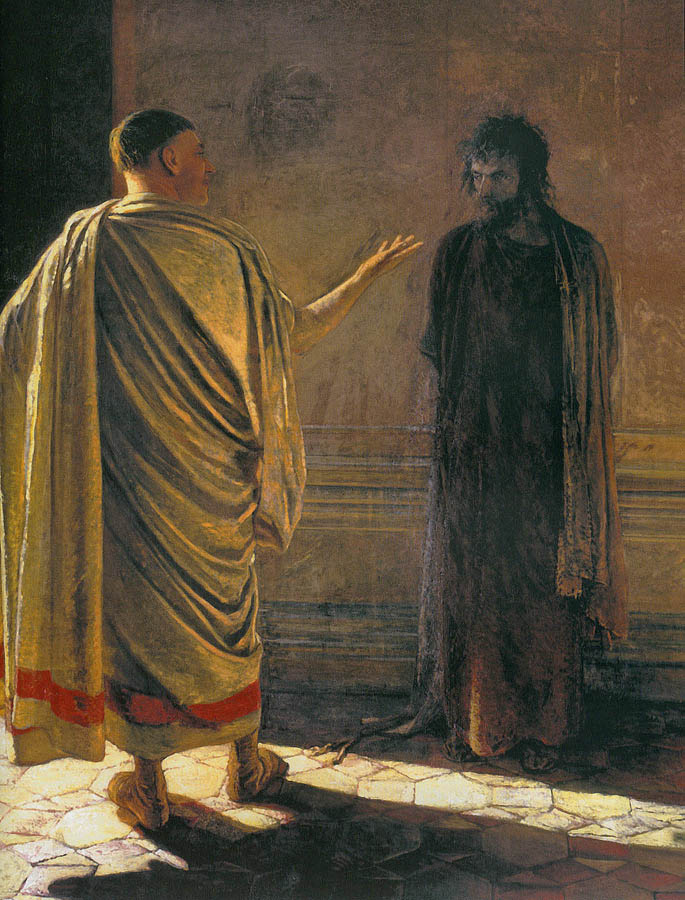
But, even if we do come to this conviction, we may find a new question that takes its place. It is the same question that Pilate famously posed to Christ: “What is truth?” It seems that the answer to that should be obvious, but any serious examination on the matter will soon uncover a few issues. Most particularly, we will likely find it difficult to distinguish what is THE TRUTH from merely “my truth.”
Consider that many of us hold different principles inside of us that we identify with the truth. Two men confronted by the same injustice might be stirred by their conscience to two different actions. One of them might feel called to meekly endure the offense, remaining patient and longsuffering. On the other hand, the other man might feel compelled to stand up for what is right and challenge the oppressor. Frankly, neither of these reactions feels fundamentally wrong to me. Perhaps towards less severe injustices the passive response seems more fitting, and towards grievous injustices the bold response, but there is a great deal of overlap where either seem entirely appropriate, and I would not call any person wrong for behaving one way or the other. But at the same time, in a single person each response is mutually exclusive to the other. So which way is actually correct?
Furthermore, two men acting in sincere accordance with their conscience is one thing, but what about the issue of us misidentifying our wants with our conscience? I’m sure we can all call out social movements that claim to be based in truth and conscience, but which are clearly just justification for selfish and immoral practices. Making matters even more complicated, while sometimes we know in our hearts that we are being dishonest, most often we really do delude ourselves into thinking that our own personal wants just happen to align with what is cosmically right. How can I recognize what is actually true, and what is just me trying to get my own way?
A Point of Reference)
Both of the issues that I have presented are a result of defining the truth locally. If each person is let alone to define their “own truth,” then there will be as many distinct truths as there are people. We will probably each settle on some genuine pieces of conscience, but also much that is colored by personality or selfish desire. Aligning ourselves with “our truth” will therefore disappoint us, both on a personal and universal level. On the personal level, it will disappoint us because we will come out looking very much the same as who we already are. We will not have any sense of transcendence, of having been called up and made into something new and better. On the universal level, we will never have unity and common purpose. We will remain entrenched in embittered battles against one another, everyone convinced of their own rightness above all others.
If this enterprise of humanity is to move forward, then there absolutely has to be some underlying, fundamental truth established outside of all of us that we can each defer to. There has to be an external truth that is real and consistent, so that we may all come into union when we separately align ourselves to it. If the truth is defined by a person, or if it is shifting in its nature, then we will never find harmony with either conscience or community.
If, however, we do settle upon a universal truth that exists outside of us all, then both of the issues mentioned above are resolved. Now we have a standard that all other “self-truths” can be compared against. Selfish desires, misinterpreted as truth, are immediately recognized as such and discarded. Also, in the example of the two men choosing differently, but according to their genuine conscience, it is possible that the universal truth is broad enough to harmonize with both decisions. While the universal truth will certainly never contradict itself, it does seem reasonable to me that it could allow some range of individual, moral choice within its domain.
Is it any wonder, then, that the bedrock of every civilization has been religion? Be it the Bible, or the Quran, or the Torah, or the Bhagavad Gita, or the words of Buddha, each culture has composed itself around words that are said to have descended from on high. They might have come through the mouths of prophets and sages, but they are not interpreted as the words of those prophets and sages. They are understood to be the words of the external, of the divine, of God in some form or another.
Cultures that detach themselves from sacred truth do not remain cultures for long. As a society they break apart and become an anarchy. As individuals they become stunted and cease to improve their situation. They lag behind the rest of the world, both technologically and ethically, and they are soon destroyed by the whims of the world.
So, going back to our idea that only the life founded upon the truth is free, even after we accept this fact we still have to identify what the truth really is. And in order to do this, we’re going to have to find a source outside of ourselves, and outside of any other person. At some point we’re going to have to find God and discover THE TRUTH for ourselves. Choosing to found ourselves upon the truth is therefore no mere decision that we make once in our current place and then have the matter resolved. Choosing to be founded upon the truth means deciding to go on a great journey. It is a quest of exploration, discovery, and refinement, and it will last us the rest of our lives and then some!
In the last post I discussed an alternative to seeking validation from other people, and that was to get our validation from God instead. I pointed to the example of Jesus, who thrived on the acknowledgement and appreciation of his divine Father. I suggested that as the children of God, our hearts are wired to need His approval, just as how every child seeks the approval of their earthly parents.
Our craving for validation from other people is therefore nothing more or less than a misconstruing of our basic need for divine validation. Yes, we need validation, but no, not from our friends and coworkers. We need to develop a relationship with God in which we can feel His approval regularly.
So, then, how do we go about doing that?
Love vs Approval)
Work hard so you can present yourself to God and receive his approval. 2 Timothy 2:15 (NLT)

And I answered him, saying: Yea, it is the love of God, which sheddeth itself abroad in the hearts of the children of men; - 1 Nephi 11:22
To start off, we need to take a moment to recognize the difference between God’s love and God’s approval. It is a common thing for those who are living a life contrary to the commandments of God to point out that He still loves them, no matter what they do. And they are absolutely right. God does love all of His children, and He loves them wherever they are in life. Even in the midst of our sins, He is able to manifest His love, and no child is beyond the reach of His grace.
But that is not the same as having God’s approval. Any parent can attest that they are perfectly capable of whole-heartedly loving their child, while not condoning their behavior. So, while there is nothing that we must do to earn God’s love, as the verse from 2 Timothy suggests, there are things that we must do to earn His approval.
And gaining the approval of God is essential to realizing our full, divine potential. As Jesus Christ, himself, attested “Not every one that saith unto me, Lord, Lord, shall enter into the kingdom of heaven; but he that doeth the will of my Father which is in heaven,” (Matthew 7:21).
In other words, the love of God is an essential component in being saved…but it isn’t the only component. There will not be any saved who did not feel the love of God, but there will be those that felt His love who are not saved. Indeed, one might say the whole point of experiencing the love of God in our lives was to inspire us to press further and seek for His approval. It is those that receive and maintain the approval of God who can be sure of their salvation.
The Key to God’s Approval)
For am I now seeking the approval of man, or of God? Or am I trying to please man? If I were still trying to please man, I would not be a servant of Christ. - Galatians 1:10

If ye love me, keep my commandments. - John 14:15

For I the Lord cannot look upon sin with the least degree of allowance; - Doctrine and Covenants 1:31
So how do we receive the approval of God? The answer is extremely straightforward. You must obey Him. One cannot approve of behavior that they do not advocate for, and God, being the source of all good, can only advocate for what which is good. God can only ever approve of those that follow the good commandments that He has given. God can love the sinner, for love does not require obedience, but God cannot approve of the sinner, for approval does require obedience.
We started this series with the question of how we could obtain the acknowledgement and approval that we crave in life. We have identified that only God can fully provide this approval, not mankind, and now we have concluded that God can only approve of those that follow His commandments. Thus, having the sense of appreciation that we desire is predicated upon our choosing to follow the commandments of God. We can try to argue our way out of this rule, but the heart will remain forever frustrated until we accept and adhere to it.
Recognizing God’s Approval)
But what if we feel that we have been following God’s commandments, yet we still do not feel His approval? What if we suspect He is already speaking His appreciation to us, but we just aren’t attuned to hearing it?
This is entirely possible. Indeed, it is almost certain that God expresses His love to us many times, every day, but that we fail to recognize most, if not all, of His messages.
So how do we pick up on these moments as they are happening? How can we start to understand God’s language better? We’ll dive into that tomorrow. I’ll see you there.
In my last post I discussed the therapeutic process of revisiting childhood trauma and mourning the things that might have never been fully processed at the time. In many cases this means finally shedding the tears that had been bottled up for far, far too long.
But I’ve been in therapy groups, and I’ve certainly seen a resistance to this process, particularly among the men who feel like openly weeping is unmanly. Is there a validity to this sense of stoicism, or is it a misalignment in our society? Well, today we will address this question by looking at the example of the greatest man that ever lived: Jesus Christ.
Become as a Little Child)
The primary reason why many feel ashamed to show their unbridled emotion is that they want to be mature and composed. They don’t want to appear as a little child. But what was it that Jesus said to his disciples about little children?
And Jesus called a little child unto him, and set him in the midst of them, and said, Verily I say unto you, except ye be converted, and become as little children, ye shall not enter into the kingdom of heaven. Whosoever therefore shall humble himself as this little child, the same is greatest in the kingdom of heaven. - Matthew 18:2-4
Humble yourself as a little child. Give up your pride and your show of false strength. Stop trying to prove that you’ve got this all taken care of and let yourself admit that you were really hurt.
And in case you aren’t sure that Jesus’s declarations applied to matters of showing one’s weakness and hurt, let us consider another example that he gave in a moment of great distress. In the Garden of Gethsemane, when he was bowed under the pain of the atonement and the anxiety of the coming crucifixion, this was his response:
And he went forward a little, and fell on the ground, and prayed that, if it were possible, the hour might pass from him. And he said, Abba, Father, all things are possible unto thee; take away this cup from me: nevertheless not what I will, but what thou wilt. - Mark 14:35-36
Jesus feels scared and hurt, and he falls on his face and calls to his “Abba.” Abba is a Hebrew word for “father,” and it denotes both intimacy and submission, something like “daddy” and “sir” all rolled into one. “Daddy/sir, you can do anything, will you take this hurt from me? But I’ll go through with it if you ask.”
Jesus has been many things to his followers. He has been called “master,” and “teacher,” and “prophet.” But to his God, Jesus is “as a little child.” Vulnerable, open about his pain, asking for help, and submissive.
Later still, when Jesus was upon the cross, he cried out in a moment of agony:
And at the ninth hour Jesus cried with a loud voice, saying, Eloi, Eloi, lama sabachthani? which is, being interpreted, My God, my God, why hast thou forsaken me? - Mark 15:34
Previously, when raised upon the cross, Jesus had been magnanimous to his killers: “Father, forgive them; for they know not what they do” – Luke 23:34. He had been considerate to the well-being of his mother: “He saith unto his mother, Woman, behold thy son!Then saith he to the disciple, Behold thy mother! And from that hour that disciple took her unto his own home” – John 19:26-27. But to his God, once again, Jesus was a little child, crying out and asking why he was alone.
To Every Thing There is a Season)
To every thing there is a season, and a time to every purpose under the heaven: A time to weep, and a time to laugh; a time to mourn, and a time to dance; - Ecclesiastes 3:1, 4
The words and example of Jesus Christ perfectly line up with these words of wisdom in Ecclesiastes. Yes, there is a time for stoicism. There is a time for power. There is a time for projecting strength and not weakness. One has only to consider Jesus chasing out the vendors in the temple with a whip to see that there is even a time for anger!
But also, there is a time for weeping, mourning, and being broken. One of the great examples of Christ, which too often goes overlooked, was how he filled the full measure of human emotion. He showed all of his feelings, at the appropriate time. Reserved when he ought to be, confident when he ought to be, distraught when he ought to be, and pained when ought to be. He assured his disciples that there was nothing to fear (Mark 4:39-40), but he also wept at the death of Lazarus (John 11:35).
To claim that you ought not feel or show an entire sector of the emotional spectrum because you are a man, is to claim that that you are more of a man than Jesus. God did not give us our feelings with the intent that we would ignore half of them, all of them were given for our good. Yes, they need to be governed and managed at times, but that does not mean suppressed out of existence!
Previously, I presented the mourning of old trauma as a matter of emotional therapy, and it is, but it is also a matter of spiritual significance as well. We cannot be the full person that God intended for us to be until we truly embrace the full person, broken inner child included.
I know by experience that Christ calls each of us to step into the hurts of our past. Not only that, he asks us to step into those places with him. He goes with us into those defeated places, he asks us to open up the hurt and let the tears flow, and then he applies his healing balm and saves the lost soul within. Mourning our old wounds, with our Savior by our side, is arguably the most sacred act that we will ever do. May we all go through this beautiful process, so that every lost child can be healed and be saved.
Thus far I have appealed to the mind and to the heart for why the addict needs to bring his secret shame to light through confession. I have shared how my own self-delusions prevented me from confessing for a time and how I was saved after I finally broke through them.
My testimony would be incomplete, however, if I did not bring up what the words of scripture have said upon the matter. It is not only good philosophy and psychology to confess, it is good religion.
And it shall be, when he shall be guilty in one of these things, that he shall confess that he hath sinned in that thing: - Leviticus 5:5

He that covereth his sins shall not prosper: but whoso confesseth and forsaketh them shall have mercy. - Proverbs 28:13

And I set my face unto the Lord God, to seek by prayer and supplications, with fasting, and sackcloth, and ashes: And I prayed unto the Lord my God, and made my confession, and said, O Lord, the great and dreadful God...we have sinned, and have committed iniquity, and have done wickedly, and have rebelled, even by departing from thy precepts and from thy judgments: - Daniel 3:3-5
In Leviticus, the book of the law, the Israelites were commanded to confess. It was one of the key steps towards forgiveness, and it was meant to be understood that cleansing would not occur until this ritual had been observed. Thus, by doctrine itself we are shown that we must confess.
Then, in the book of Proverbs we are told that he who does not confess shall not prosper. The book of Proverbs is not a statue of law like Leviticus. It is a collection of wisdoms observed from Solomon’s life experience. Thus, by the words of wise counsel we are again told that we must confess.
And finally, in the book of Daniel, we see the prophet in a moment of personal spiritual practice. Daniel is not performing a formal ritual or giving an address to others, he is being compelled by his own conscience in a personal act. Something in his heart just tells him that he needs to be “confessing my sin and the sin of my people” (verse 20). Thus, by the example of righteous people we also see that we must confess.
By doctrine, by wisdom, and by example, the scriptures make clear that the sinner who wishes to be clean must make their confession.
“But,” one might say, “couldn’t this only mean confession to God? Do the scriptures really say that I have to bring imperfect human beings into the matter? I’ll just work things out with God and that should be enough.” Well, let’s see if the scriptures do have anything to say on that matter.
Confession to Others)
Then went out to him Jerusalem, and all Judæa, and all the region round about Jordan, and were baptized of him in Jordan, confessing their sins. - Matthew 3:5-6

Confess your faults one to another, and pray one for another, that ye may be healed. - James 5:16

Many of those who believed now came and openly confessed what they had done. - Acts 19:18
Here we have three verses that speak to the need for confession to others is addition to God. The passage in Matthew definitely seems to be suggesting that those who were baptized of John the Baptist were making known to him exactly what wrongs they were having washed away by his baptism. The passages in James and Acts make even more explicit the fact that the early saints were confessing “one to another,” and doing so “openly.”
In my personal experience, the need to confess to another human soul is due to our misconception that our faults make us incapable of being loved by another person. We need to break that illusion, and the only way to do so is to confess to another and see how they respond. Some of the most powerful moments of my life have been sitting in a twelve-step group where I have shared the deepest, most vulnerable parts of myself, and then had my brothers look me in the eye and say “Abe, me too. I’ve been right there myself and I want you to know that I still love you. You may still be in the ugly parts of your journey, but I absolutely respect you for taking this step in the right direction.”
Yes, these are messages that we need to hear from God directly, and at special moments He does say them directly to us. But in my experience, He usually reminds me of these messages through His living angels, the brothers and sisters all around me. When I find a safe place, among godly people, and I make my confession to them, then they are flooded with the love of God and speak to me the words that He gives them.
The Promises of Christ)
We have looked at the words and examples of prophets and apostles, both in the Old Testament and in the New. We have considered my personal experiences as well. But what of the words of Christ, himself? What promises has he made to those who come forward and make confession?
Whosoever shall seek to save his life shall lose it; and whosoever shall lose his life shall preserve it. - Luke 17:33

A new heart also will I give you, and a new spirit will I put within you: and I will take away the stony heart out of your flesh, and I will give you an heart of flesh. - Ezekiel 36:26
No doubt these verses have several applications, but one of them is most certainly to this matter of confession. I have already mentioned how the addict tries to hide his shame because he is trying to preserve his sham life. Christ assures us that the preservation of the old will ironically end in its destruction. The only way forward is to give up the old life. Once we shine a light on the secret, then the secret life dies, replaced with one of authenticity. Lose your life of fearful self-management and give birth to a new one of faithful surrender. The stony heart comes out and one of flesh takes its place.
And he said to them all, If any man will come after me, let him deny himself, and take up his cross daily, and follow me. - Luke 9:23
What a fitting description for the addict who overcomes his fears and rationalizations and embraces confession! To do this he must overcome his every basic nature, the pattern he has lived his whole life by, the very reasoning of his own mind. He must “deny himself,” take up the cross of the thing he dreads most, confession, and follow Jesus into that crucible.
Paul communicated this same idea to the Galatians when he wrote “I am crucified with Christ: nevertheless I live; yet not I, but Christ liveth in me:” (Galatians 2:20). Denying ourselves and taking up our cross leads to being “crucified with Christ.” Many the addict has said that he felt like making his confession would kill himself. That sounds like hyperbole until you consider it in this spiritual sense. They were actually right; it would kill them. The carnal them! But in that crucifixion, they discovered Christ living within them. Through and in and of him, they were saved.
For my yoke is easy, and my burden is light. - Matthew 11:30
I mentioned in my last post that as terrible as the consequences of confession might seem, they end up being miraculously less than what we expect. First, because almost every addict finds that the world and nature are kinder and more forgiving than they had given them credit for. Their sins had made them cynical, and they had then projected that cynicism onto the world. And secondly, because even when a burden does come, it is tremendously alleviated by the sense of new life within.
And this is exactly what Christ promises us in this verse from Matthew. His yoke and his burden may have some weight, but they are easy and light, certainly far more so than the iron shackles we’ve been dragging around thus far!
***
In the end, I did not make the decision to confess because I was convinced of the promises in these scriptures. I had heard them, and at times they did stir something within me, but I was far beyond faith when I finally gave in to the truth. I did not unveil my shame because I expected salvation, I did it because I was finally willing to accept damnation.
But, as it turns out, these verses make no requirement for the disciple to have the right expectations when he makes his confession. I found out for myself that you can take this step for virtually none of the right reasons, and mercy will still swoop down and make its claim upon you. It was only in hindsight, after I had already had the reality of these promises come true in my life, that I read these verses and realized that I had engaged in a contract with God without ever realizing it. In hindsight I can testify with all my heart that these promises are true. They were true for me, right down to the smallest detail, and they will be true for you!




 Spiritual Wanderings